
KAT6 NEWS & STORIES
Latest updates from the KAT6 Foundation
Find stories of hope, updates from the foundation, international news, and more!
Featured blog posts
KAT6 Clinic Opens at Boston Children's Hospital
Major Development: A KAT6 Clinic Has Opened at Boston Children’s Hospital
We’re excited to share that a new multidisciplinary clinical program for individuals with KAT6A and KAT6B is now open at Boston Children’s Hospital, led by Dr. Olaf Bodamer and Dr. William Brucker. This clinic will serve as a true medical home for families, offering coordinated care across specialties.
The KAT6 Foundation is proud to have helped fund the development of this program, made possible through the generosity of our donors.
As the team continues organizing the clinic, families who are interested in care are encouraged to contact rarediseases@childrens.harvard.edu. This inbox is monitored several times a day, and families can expect a response within 24 to 48 hours. After reaching out, families will receive an intake form and the opportunity for a brief informal meeting to discuss expectations. Appointments for an initial evaluation are available on a regular basis with Dr. Brucker and/or Dr. Bodamer.
In addition to patient care, the clinic will gather natural history data and collect biospecimens for the IRB-approved KAT6 biorepository, which supports ongoing biomarker discovery. The clinicians will also continue collaborating with research partners such as the Serrano Lab at Boston University.
For appointments or additional details, families can reach the clinic coordinator at rarediseases@childrens.harvard.edu
300 Longwood AvenueBoston, MA 02115

Rare Should Never Mean Invisible
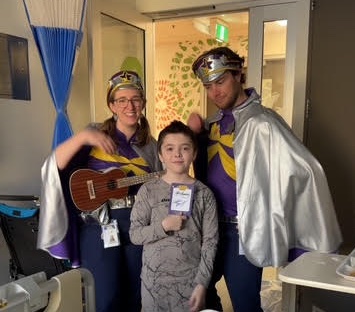
Eleven-year-old Christopher from Adelaide, South Australia is vibrant, funny and deeply compassionate. He is my cherished son and my constant “wingman.”
He loves video games and, most of all, animals, especially Molly, our miniature dachshund. These simple joys sustain us amidst the daily realities of living with his complex KAT6B-related disabilities.
Christopher has a rare genetic change in the KAT6B gene, meaning his body is missing a protein critical for regulating development and repair across multiple body systems. This has a significant impact on his bones, muscles, and connective tissue, affecting far more than what people can see.
Over the past year, Christopher has experienced significant regression in both his health and functional capacity due to his KAT6B-related disabilities. He has not been able to attend school since May 2025. His hospital and therapy teams continue searching for answers in a space where there is very limited research and understanding to guide them. Living with an ultra-rare condition often means facing uncertainty without a roadmap.
As his mum, my role has become one of constant learning and fierce advocacy. I have learned to trust my instincts and to speak up because parental insight matters. There have been critical moments where advocating strongly led directly to important treatment decisions. Families like ours are not just carers; we are part of the clinical picture.
Christopher’s resilience and gentle nature inspire me every single day. But inspiration alone is not enough.
We urgently need:
• Increased research into ultra-rare genetic conditions like KAT6B
• Better clinical guidelines and standards of care
• Greater awareness within medical and disability communities
We are incredibly grateful to the KAT6 Foundation, which proudly funds and supports international research by connecting families to current research studies. In a world where rare conditions can feel isolating, the Foundation provides hope, direction, and a sense of global community. Their work is vital in moving us closer to understanding, treatments, and better outcomes for children like Christopher.
Rare should never mean invisible.
On Rare Disease Day 2026, I share Christopher’s story to raise awareness for the KAT6 community because children like Christopher deserve answers, targeted therapies, and a future built on understanding, not uncertainty.
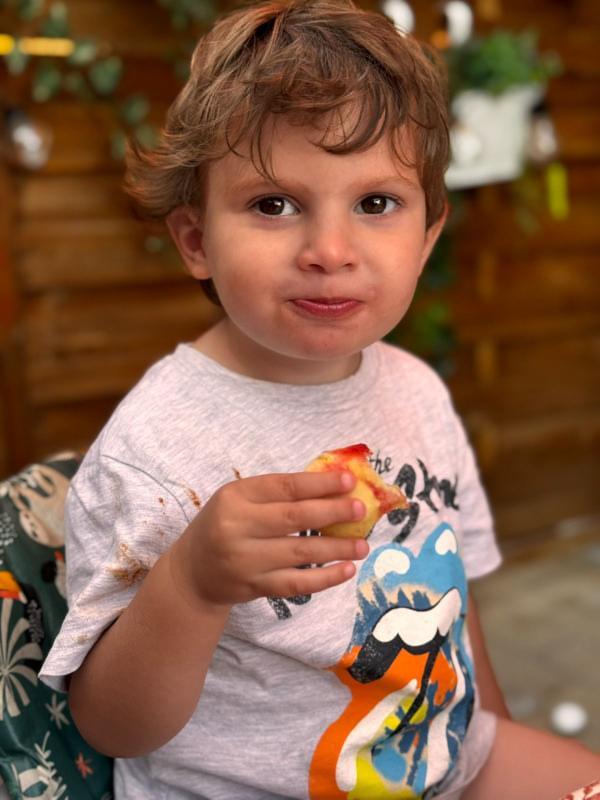
Questo è Samuele
Ciao a tutti,
Questo è Samuele. È nato il 5 aprile 2022 e, fin dai suoi primi giorni, ha riempito le nostre vite di un amore difficile da spiegare a parole.
Nei primi mesi di vita, però, qualcosa non tornava. Samuele faceva fatica a fissare e mantenere lo sguardo di mamma e papà. Erano piccoli segnali, quasi impercettibili per molti, ma non per la sua mamma, Serena, educatrice d'infanzia. Il suo sguardo esperto e il suo cuore di mamma avevano già capito che c'era qualcosa da approfondire.
Per mesi si è tenuta dentro dubbi e paure. Poi, il 9 agosto, ha trovato il coraggio di condividere tutto con il papà. Da quel momento è iniziato un percorso che ci ha portato presso l'Ospedale Bellaria di Bologna, seguiti dalla Dott.ssa Paola Visconti (Neuropsichiatria Infantile – IRCCS).
All'inizio l'ipotesi era quella di un disturbo dello spettro autistico. Ci dissero che era "uno dei più piccoli mai visti e con tratti tra i più marcati". Parole che fanno tremare le gambe.
Samuele ha iniziato prestissimo la neuropsicomotricità e la piscina, già a 9 mesi, perché presentava una forte ipotonia.
In tutto questo, la mamma non si è mai arresa. Con amore, passione ed estrema dedizione ha messo tutta se stessa in ogni esercizio, in ogni gioco trasformato in terapia, in ogni piccolo progresso conquistato giorno dopo giorno. Sempre con un obiettivo: fare un passo in più. Anche minuscolo. Ma in più.
Oggi Samuele ha quasi quattro anni. Ha buone capacità di comprensione, considerando la sindrome, e buone competenze motorie. Parla usando singoli vocaboli, detti a modo suo, ma chi lo conosce sa perfettamente cosa vuole dire. La valutazione cognitiva ha evidenziato un QI pari a 88, un dato che racconta molto più potenziale di quanto si possa immaginare.
Il 28 novembre 2025 è arrivata la diagnosi genetica: sindrome KAT6A. Una malattia rara, di quelle che ti costringono a studiare, a cercare, a confrontarti con altri genitori nel mondo, a diventare esperto per necessità.
Ma prima di qualsiasi diagnosi, prima di qualsiasi sigla, Samuele è un bambino. È un bimbo felice. Entusiasta della vita. Ama il suo cane Joy, viaggiare, sperimentare cose nuove, mangiare (da buon italiano questa è una delle sue passioni più grandi!), fa basket, continua ad andare in piscina ed è amato da tutti i suoi compagni.
Ai suoi genitori Samuele ha insegnato che le etichette non definiscono una persona. Che i tempi possono essere diversi, ma il valore è lo stesso. Che la forza non fa rumore, ma costruisce ogni giorno.
E questa è solo l'inizio della sua storia.
This is Samuele
Hi everyone,
This is Samuele. He was born on April 5th, 2022, and from his very first days he filled our lives with a kind of love that is hard to put into words.
In his first months, however, something didn't feel quite right. Samuele struggled to fix and maintain eye contact with mom and dad. They were small signs, almost imperceptible to many, but not to his mother Serena, an early childhood educator. Her trained eye and her mother's heart already knew that something needed to be explored further.
For months she kept her doubts and fears to herself. Then, on August 9th, she found the courage to share everything with his dad. From that moment on, a journey began that led us to the Bellaria Hospital in Bologna, where we were followed by Dr. Paola Visconti (Child Neuropsychiatry – IRCCS).
At first, the hypothesis was autism spectrum disorder. We were told he was "one of the youngest ever seen, and with some of the most marked traits." Words that make your legs tremble.
Samuele started neuropsychomotor therapy and swimming very early, at just 9 months old, due to significant hypotonia.
Throughout all of this, his mother never gave up. With love, passion, and extraordinary dedication, she put all of herself into every exercise, every game turned into therapy, every small achievement earned day after day. Always with one goal: to take one more step forward. Even a tiny one. But forward.
Today Samuele is almost four years old. He has good comprehension skills, considering the syndrome, and good motor abilities. He speaks using single words, pronounced in his own way, but those who know him understand perfectly what he wants to say. His cognitive evaluation showed an IQ of 88, a number that speaks of far more potential than one might imagine.
On November 28th, 2025, we received the genetic diagnosis: KAT6A syndrome. A rare condition, the kind that forces you to study, to search, to connect with other parents around the world, to become an expert out of necessity.
But before any diagnosis, before any label, Samuele is a child. He is a happy little boy. Full of enthusiasm for life. He loves his dog Joy, traveling, trying new experiences, eating (as a true Italian, this is one of his greatest passions!), he plays basketball, continues swimming, and is loved by all his classmates.
To his parents, Samuele has taught that labels do not define a person. That timelines may be different, but value is the same. That strength does not make noise — it builds, quietly, every single day.
And this is only the beginning of his story.
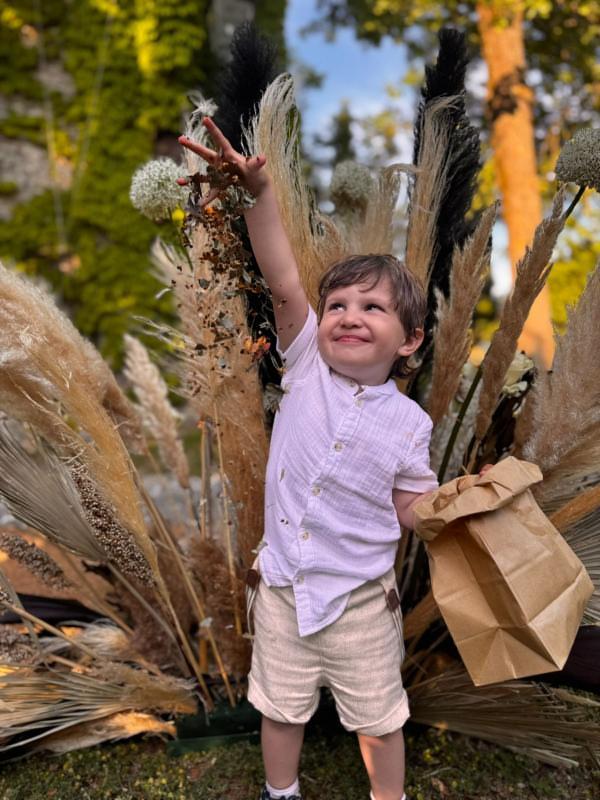

Fyona’s Journey with KAT6: A German Family’s Story
Our story is filled with sadness, fear, and despair, but also with a great deal of hope and love.
We are from Germany, in the state of Rhineland-Palatinate — more specifically, from the Westerwald region. We are a small family: mom (Jessica), dad (Daniel), and two children. Our “big” girl, Katelyn, just turned seven, and our little one, Fyona, is four years and six months old and will turn five in April.
From the moment she was born, I (Jessica) felt that something wasn’t right. After birth, Fyona wouldn’t breastfeed. It took hours before she finally latched. She was relatively small and light at birth, which didn’t worry me at first because Katelyn had also been small — not quite as small as Fyona, but still similar. We were allowed to go home, and that’s when the nightmare began. Whether breastfeeding or not, whether asleep or awake, Fyona constantly choked. She would gag, stop breathing, turn blue, and then vomit. Day in and day out. We went from doctor to doctor. No one could help. Everything was brushed off as if we were imagining it. We saw a pulmonologist, but he said everything looked fine.
Fyona wasn’t vaccinated until she was eight months old because she was constantly sick, but the pulmonologist said that as long as she didn’t have a fever, she should be vaccinated. So we did. At eight months, she began sitting up, and the episodes of turning blue became less frequent, but the choking, gagging, and vomiting continued. She would eat fruit purée pouches and vomit afterward as well (I suspect hunger was the only reason she tried to eat something she apparently couldn’t tolerate). She gained weight poorly, wasn’t growing, and refused both drinking and solid foods. The moment any puréed food touched her lips, she started gagging and vomiting.
We went from hospital to hospital and clinic to clinic. Again and again I heard the same thing: “Breastfeeding until age three is normal — if she’s hungry, she’ll eat.”
We had never felt so helpless and abandoned. You watch your child grow thinner and fear how long her body can handle it, all while fighting with doctors just to be taken seriously. Comments like that drove us to despair.
I tried to explain that breast milk is only calorie-rich during the first year and afterward is basically just fluid. I felt like no one was listening.
In one clinic, they diagnosed failure to thrive, developmental delay, a speech disorder, esophageal reflux, esophagitis, and constipation. Then we were sent home with tablets to dissolve, even though I sat in front of the doctor in tears explaining my fears. The only response was, “A cow doesn’t stop giving milk,” and that with enough liquid she would take the tablets. I was so shocked I could only cry. We went home, but she wouldn’t take the tablets, not even with a syringe in her mouth — everything came right back up.
Since birth she couldn’t tolerate anything touching her body. If she touched sand outside, her hands had to be cleaned immediately. Nothing was allowed on her face. Our doctor prescribed speech therapy, but didn’t think occupational therapy was necessary. We had to fight for every bit of help. We discussed a PEG tube with the doctor, but she didn’t think it was needed. After a long back and forth, we were finally told to go to the hospital for a nasogastric tube. I explained how sensitive Fyona is around her face, and they still wanted to try. Only if it failed would they consider a PEG.
We went, and they tried three times to place the tube. I have never felt so much pain and anger. I had to hold her on my lap, holding her arms while one nurse held her head and another her legs. They tried placing the tube; Fyona’s nose started bleeding and she gagged and vomited again. Then they tried the other nostril. I was tense and told them this had to be the last attempt. Same result. After that they said they would try once more with her lying down. Another nurse came. Again her head, arms, and legs were held down. After a struggle, they managed to place the tube, but she wasn’t even sitting up yet before she pulled it out again. We finally received a date for a PEG placement.
On December 24, 2023, we had to go to the hospital in the evening. She had an infection and constant fevers over 40°C, which we couldn’t control because she couldn’t take anything orally, and suppositories were extremely painful due to her constipation. At the hospital, they admitted us. She was exhausted and had a streptococcal infection. One doctor initially said we would get oral antibiotics and could go home, even though I had explained she couldn’t take anything by mouth. We were then admitted after all. She was given IV fluids and antibiotics. Later she also received Nexium and folic acid. Then they gave her iron intravenously, telling me to alert them if I noticed redness around the IV site. I did when it started turning red. They said they’d monitor it and to tell them if it increased. It got worse — she turned red all over, vomited, and became unresponsive. I cannot describe the thoughts that went through my mind. It was unbearable. She lay in my arms motionless. The doctor came quickly; they checked her oxygen level and blood pressure, disconnected her from the IV, and administered medications. Her oxygen was low, and she was put on oxygen and taken to monitoring. She slowly came back — a moment I will never forget.
She developed one infection after another: strep, RSV, and influenza. We were in the hospital from December 24, 2023, until January 18, 2024. On January 4, the PEG tube was placed. During this entire time, Katelyn wasn’t allowed to visit because we were on an infectious disease ward.
Feeding remained difficult — the vomiting continued. Later, in another clinic, her PEG was changed to a button PEG. There, they suggested that because I had struggled with an eating disorder (which I have well under control), my daughter might have one as well. No one should be made to feel such guilt.
The good part was that the doctor said, since they didn’t know what else to do, they would finally do a genetic test. I had been fighting for that test for two years — no doctor thought it was necessary.
On November 5, 2018, we received the diagnosis: Arboleda-Tham Syndrome (KAT6A).
It hit us hard, but at least the uncertainty was over and the constant hospital stays finally had an explanation.
Despite everything, Fyona is a happy child with a big heart.
We share her journey to raise awareness, give others courage, and hopefully connect with other affected families.
Because even though daily life is often difficult, it is full of love.
Thank you for taking the time to read our story.
Warm regards,
Jessica
German Version:
Unsere Geschichte ist mit viel Traurigkeit, Angst, Verzweiflung aber auch mit viel Hoffnung und Liebe zu erzählen.Wir kommen aus Deutschland/ Rheinland-Pfalz wenn mans genau nimmt aus dem Westerwald.Wir sind eine kleine Familie Mama(Jessica), Papa(Daniel) und 2 Kinder, die ,,große'' Maus heißt Katelyn und ist 7 Jahre alt geworden, die kleine Maus Fyona ist 4 Jahre und 6 Monate, wird im April 5 Jahre alt.
Unsere Geschichte etwas zusammengefasst:
Von Geburt an hatte ich (Jessica) das Gefühl, dass etwas nicht stimmt. Fyona wollte nach der Geburt nicht gestillt werden, es hat stunden gedauert bis sie sich hat stillen lassen. Sie war relativ klein und leicht bei der Geburt, dass mir zu Beginn jetzt aber keine Sorgen machte, da Katelyn auch relativ klein und leicht war, nicht ganz wie Fyona aber doch schon nah dran.
Wir durften nach Hause und da fing der Horror erst an. Ob gestillt oder nicht ob schlafend oder wach, Fyona verschluckt sich ständig, bis Ie anfing zu würgen, keine Luft mehr zu holen - blau wurde und dann erbrochen hat. Tag ein Tag aus. Wir sind von Arzt zu Arzt. Keiner konnte helfen. Es wurde alles runter gespielt als würden wir uns das alles einbilden. Wir waren beim Pneumologe aber er sagte es sei alles in Ordnung.
Fyona wurde bis zum 8. Monat nicht geimpft, da Sie ständig Infekte hatte aber der Pneumologe sagte solang sie kein Fieber hat soll sie geimpft werden. Haben wir dann auch gemacht.
Mit 8 Monaten fing sie an zu sitzen, da wurde es mit dem blau werden besser, das verschlucken, würgen und brechen blieb leider. Si2 nahm Quetschies zuvsich und erbrach dansch auch wieder (ich vermute es war der Hunger, weshalb sie eas zu sich nahm was sie anscheinend nicht konnte).
Sie nahm schlecht zu, ist nicht wirklich gewachsen, hat Trinken und Beikost komplett verweigert, sobald sie etwas Brei an den Lippen hatte fing sie an zu würgen und zu Erbrechen.
Wir sind von Krankenhaus zu Krankenhaus von Klinik zu Klinik, immer wieder habe ich nur gehört: ,,Ja bis 3 Jahre stillen sei ja normal, wenn sie Hunger hat wird sie schon essen".
So Hilflos und alleingelassen haben wir uns noch nie Gefühlt. Man muss zusehen wie sein Kind immer schmaler wird, hat Angst wie lange das gut geht und muss bei den Ärzten drum kämpfen geholfen zu bekommen. Solche Aussagen haben uns Verzweifeln lassen.
Ich habe versucht den Ärzten zu erklären, dass die Muttermilch nur das 1. Jahr kalorienreich ist, danach nur noch Flüssigkeit. Ich fühlte mich, als würde mir keiner zuhören.
In einer Klinik wurde dann die Gedeihstörung, Entwicklungsverzögerung, Sprachstörung, Ösophagealer Reflux, Ösophagitis, Obstipation festgestellt. Dann wurden wir mit Tabletten zum Auflösen nach Hause geschickt, obwohl ich weinend vor dem Arzt saß und ihm meine Ängste und Befürchtungen mitteilte.
Dann hieß es nur: ,,Eine Kuh hört auch nicht auf Milch zu geben" und mit Flüssigkeit wird sie die Tabletten schon nehmen. Ich wsr so geschockt das mir nur die Tränen gelaufen sind ich aber kein Wort mehr raus bekam.
Wir sind heim, sie nahm die Tabletten nicht auch nicht lit einer spritze im Mund, es kam immer wieder alles raus.
Ebenso konnte sie von Anfang an nichts am Körper ertragen (Wenn sie draußen in den Sand mit den Händen kam, mussten diese immer direkt sauber gemacht werden. Es durfte auch nichts ins Gesicht.)
Unsere Ärztin verschrieb uns Logopädie, aber Ergotherapie hielt sie nicht für nötig. Man kämpfte für jedes bisschen.
Wir haben mit dem Arzt über eine PEG-Anlage diskutiert, hielt sie nicht für nötig. Dann nach langem hin und her sollten wir ins Krankenhaus für eine Nasogastrale-Sonde.
Ich erklärte ihr wie empfindlich sie im Gesicht ist und dann sollte dort ein Schlauch herlaufen und festgelegt werden. Wir mussten hin und erst wenn das nicht klappt, würde sie die PEG-Sonde akzeptieren.
Wir waren da 3 mal wurde versucht die Sonde zu legen, so viel Hass und Schmerz habe ich noch nie empfunden. Ich habe Sie auf meinen Schoß genommen und sollte die Arme festhalten, eine Schwester hielt den Kopf, eine andere die Beine.
Sie versuchten die Sonde zu legen. Fyona blutete bereits aus dem Nasenloch etwas und würgte und hat sich wieder übergeben. Dann noch ein Versuch auf der anderen Seite. Ich stand schon unter Spannung und habe gesagt das ist das letzte mal.
Das selbe Spiel bei dem anderen Nasenloch.
Dann wollte sie das im Liegen versuchen, der letzte Versuch um eine PEG gewährt zu bekommen. Quälerei mehr war das nicht.
Im Liegen kam noch eine Schwester dazu. Ihr wurde der Kopf, die Arme und die Beine wieder festgehalten. Sie legte die Sonde. Nach hin und her hat es geklappt, fyona saß noch nicht und hat sie sich wieder gezogen.
Wir bekamen einen Termin für eine PEG-Anlage.
Am 24.12.2023 mussten wir abends ins Krankenhaus. Sie hatte einen Infekt und ständig über 40 Fieber was wir nicht runter bekamen, da Sie oral nichts zu sich nahm und Zäpfchen so schmerzhaft waren durch ihre Verstopfungen.
Im Krankenhaus wurden wir dann aufgenommen. Sie war exsikkiert und hatte eine Infektion mit Streptokkoken.
Dann hieß es bei dem 2. Arzt wir bekommen Antibiotikum mit und können gehen, obwohl ich vorher erklärte dass sie oral nichts zu sich nimmt. Dann wurden wir doch aufgenommen.
Sie bekam Infusionen (Flüssigkeit und Antibiotikum). Dann bekam sie im Verlauf auch Nexium und Folsäure dazu.
Dann wurde Eisen intravenös gegeben. Ich sollte mich melden wenn ich sehe dass sie rot um den Zugang wird.
Das habe ich gemacht als sie rot wurde. Dann hieß es ja wir beobachten das, ich sollte mich melden wenn es schlimmer wird.
Es wurde schlimmer. Sie wsr rot am ganzen Körper, hat sich übergeben und war nicht mehr ansprechbar.
Meine Gedanken in dem Moment möchte man keinem erzählen. So unerträglich.
Sie lag bei mir im Arm und regte sich nicht.
Die Ärztin kam direkt. Ihr wurde der Sauerstoffgehalt gemessen, der Blutdruck. Sie wurde von der Infusion abgemacht, ihr wurden Medikamente gespritzt.
Der Sauerstoffgehalt war schlecht. Sie wurde an ein Sauerstoffgerät gehangen und blieb in der Überwachung.
Sie kam langsam wieder zu sich, ein Moment den ich nie wieder vergessen werde.
Sie bekam ein Infekt nach dem anderen: Streptokkoken, RS-Virus und Influenza.
Wir waren vom 24.12.23 bis zum 18.01.24 in der Klinik. Am 04.01.24 wurde die PEG gelegt.
Eine Zeit in der uns Katelyn nicht besuchen durfte, da wir auf einer Infektionsstation lagen.
Der Anfang mit der Nahrung war auch nicht einfach, das Erbrechen hörte nicht auf.
Danach waren wir später nochmal in einer Klinik. Da wurde ihr die PEG zu einer Button-PEG gewechselt.
Da hieß es dann da ich eine Essstörung hatte (die ich gut im Griff habe) kann das meine Tochter auch haben. Solche Schuldgefühle habe ich keinem gewünscht.
Das gute war, der Arzt hat gesagt weil sie nicht mehr wussten was sie noch machen sollten machen wir noch ein Gentest.
Darum habe ich 2 Jahre gekämpft. Kein Arzt hielt es für nötig.
Am 5.11.2018 bekamen wir dann die Diagnose Arboleda-Tham-Syndrom (KAT6A).
Ein Schlag den wir nicht erwartet hatten, aber die Ungewissheit hat ein Ende und die ganzen Klinikaufenthalte auch.
Trotz allem ist Fyona ein fröhliches Kind mit einem großen Herzen.
Wir teilen Ihren Weg, um aufzuklären, anderen Mut zu machen und vielleicht ein Austausch mit betroffenen Familien zu ermöglichen.
Denn auch wenn der Alltag oft schwer ist, ist er voller Liebe.
Danke, dass Sie sich die Zeit nehmen unsere Geschichte zu lesen.
Liebe Grüße
Jessica

Latest blog posts
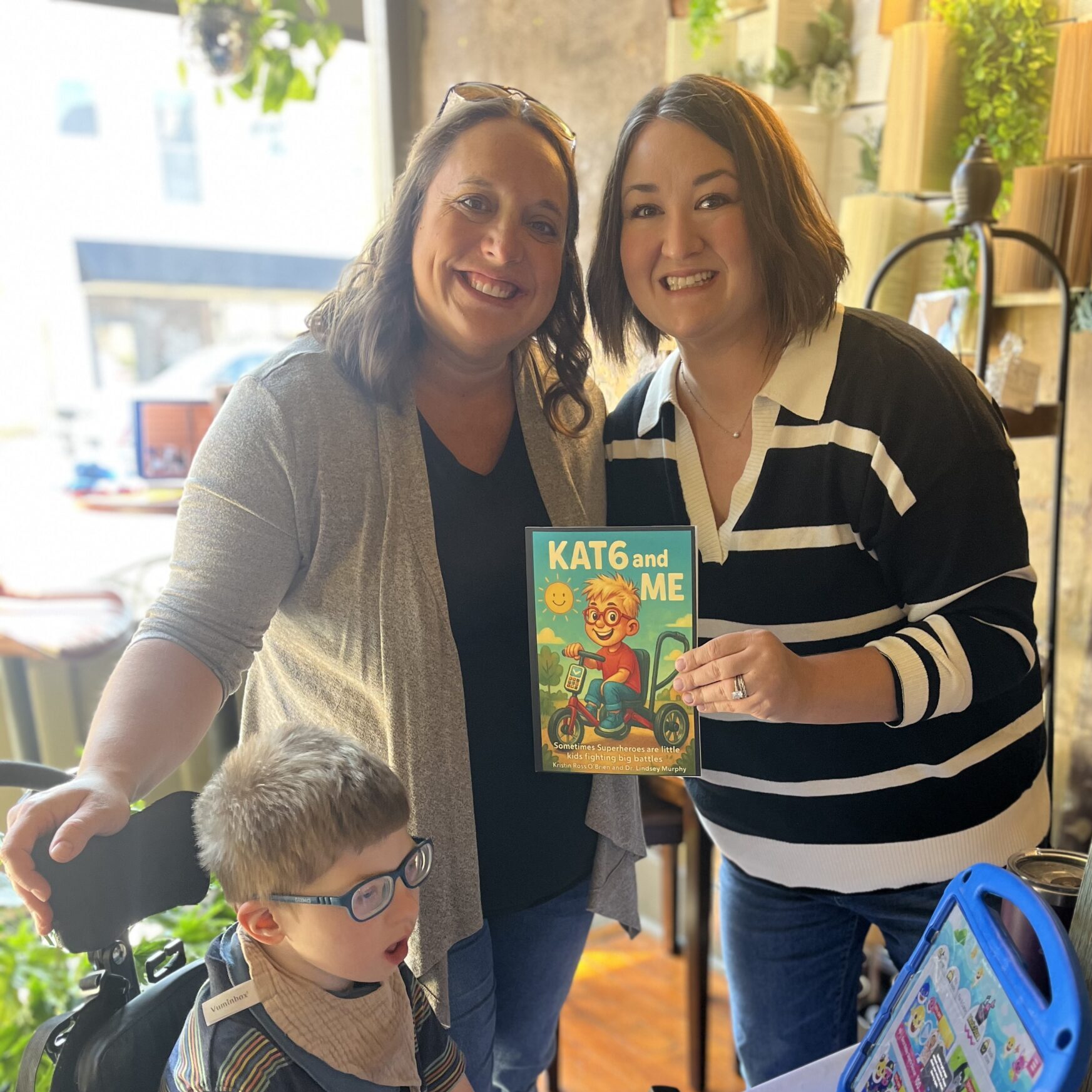
The Story Behind 'KAT6 and Me': Turning a Family's Journey into Hope
When Kristin Ross O’Brien’s son Max wanted to write a school report about his younger brother’s rare genetic condition, she made a surprising discovery; there were no children’s books about KAT6.That moment sparked a dream: to create the story that didn’t yet exist.Together with her friend and child life specialist, Dr. Lindsey Murphy, Kristin brought that dream to life in KAT6 and Me; a beautifully written and illustrated book that teaches, comforts, and celebrates children living with KAT6 disorders, while helping others understand and include them.“The idea for KAT6 and Me began with Max,” Kristin recalls. “He wanted to write about KAT6, but there weren’t any books, not even for adults. From that moment, it became our family’s wish to one day write the children’s book that didn’t exist; a story that could teach, comfort, and celebrate kids like Bash, and help others understand them too.”
A Collaboration Built on Friendship and Shared Purpose
Kristin shared her idea with longtime friend Dr. Lindsey Murphy, an associate professor of child life at Missouri State University. The connection between the two was immediate.“I’ve been a witness to Bash’s journey from the beginning,” Lindsey says. “Knowing there was something tangible I could do to support their efforts for education, inclusion, and advocacy was an easy ‘yes.’”The writing process flowed naturally.“We’d already been friends for years, connected through a playgroup for our kids,” Lindsey explains. “Kristin brought the heart and soul. She knows her child and the KAT6 community better than anyone. My background as a child life specialist helped us make complex or emotional topics understandable for children. Together, we blended those strengths.”Kristin agrees that the process was both heartfelt and fulfilling.“We wrote this book in the fringes of our lives- over coffee while our kids happily destroyed the playroom,” she laughs. “We talked about how to highlight Bash’s abilities instead of just his challenges, and how to weave facts into storytelling that still felt magical.”
The Heart of the Story: Bash
At the center of KAT6 and Me is Bash, Kristin’s youngest son, whose journey has inspired many.“Bash came into our lives first as our foster son when he was six months old and instantly captured our hearts,” Kristin shares. “Before he turned two, we were blessed to officially adopt him and make him a forever part of our family.”Diagnosed with KAT6B syndrome as an infant, Bash’s life has been filled with both challenges and incredible joy. Despite facing multiple therapies, surgeries, and medical complexities, his optimism and determination shine through.“Every small victory, every sound, and every step for Bash is a celebration,” Kristin says. “He’s a kindergartener, a disability advocate, and even a playground philanthropist. . . helping bring adaptive playground equipment to our small town. His happy personality touches everyone he meets.”
A Bridge for Families, Educators, and Professionals
Both authors hope KAT6 and Me will serve as more than a story. They see it as a bridge for connection and understanding.“For families, I hope this book gives language they can use to explain a diagnosis in a positive, age-appropriate way,” Lindsey says. “For professionals, I hope it reminds them that small gestures, listening, explaining clearly, offering hope — make a lasting impact.”Kristin adds,“My greatest hope is that KAT6 and Me becomes a bridge. I want families who are newly diagnosed to feel less alone. I want siblings to have words that help them explain and celebrate their brothers and sisters. I want teachers and classmates to see what inclusion looks like- to recognize that kids with complex needs have the same love of laughter, friendship, and play as any other child.”
A Ripple of Awareness
Since its release, KAT6 and Me has reached far beyond the rare disease community.“We expected families affected by KAT6 to be our main audience,” Lindsey notes, “but teachers, advocates, and libraries across the world have embraced it as a tool for inclusion and awareness.”Kristin and her family have shared the book through local events and readings in Boonville, Missouri, and have donated copies to schools, hospitals, and libraries.“Parents of children with rare diagnoses have sent us pictures of their kids holding the book,” Kristin says. “Teachers have told us they’re using it to start conversations in classrooms. And siblings, kids like my Jack, Max, and Leah, now have a way to explain and understand their brother’s condition. That’s exactly what we dreamed this book could do.”
Giving Back to the Community
To honor the children and families affected by KAT6 disorders, all royalties from KAT6 and Me are donated to the KAT6 Foundation to support research, awareness, and family connection.“Every purchase helps fund the search for answers and celebrates children like ours,” Kristin explains.Lindsey and Kristin’s collaboration continues, with plans for additional projects to serve families across the KAT6 community.“Our conversations keep sparking new ideas,” Lindsey says. “We already have plans for more books to reach other audiences within the KAT6 community.”
A Story That Connects and Inspires
What began as a school project has grown into a heartfelt movement of awareness and inclusion. Through KAT6 and Me, Lindsey Murphy and Kristin O’Brien remind readers that every story, no matter how small, has the power to connect, to teach, and to bring hope to families everywhere.“I learned that hope grows when it’s shared,” Kristin reflects. “Every message from another family, every photo of a child holding the book, reminds me that stories can connect people who might have otherwise felt alone.”About the AuthorsKristin Ross O’Brien is a writer, advocate, and mother of four living in Boonville, Missouri. Her family is passionate about inclusion and rare disease awareness.Dr. Lindsey Murphy is an Associate Professor of Child Life at Missouri State University and a dedicated advocate for children with complex medical needs.Read More about their journey in Q&A: Dr. Lindsey Murphy and Kristin Ross O'Brien

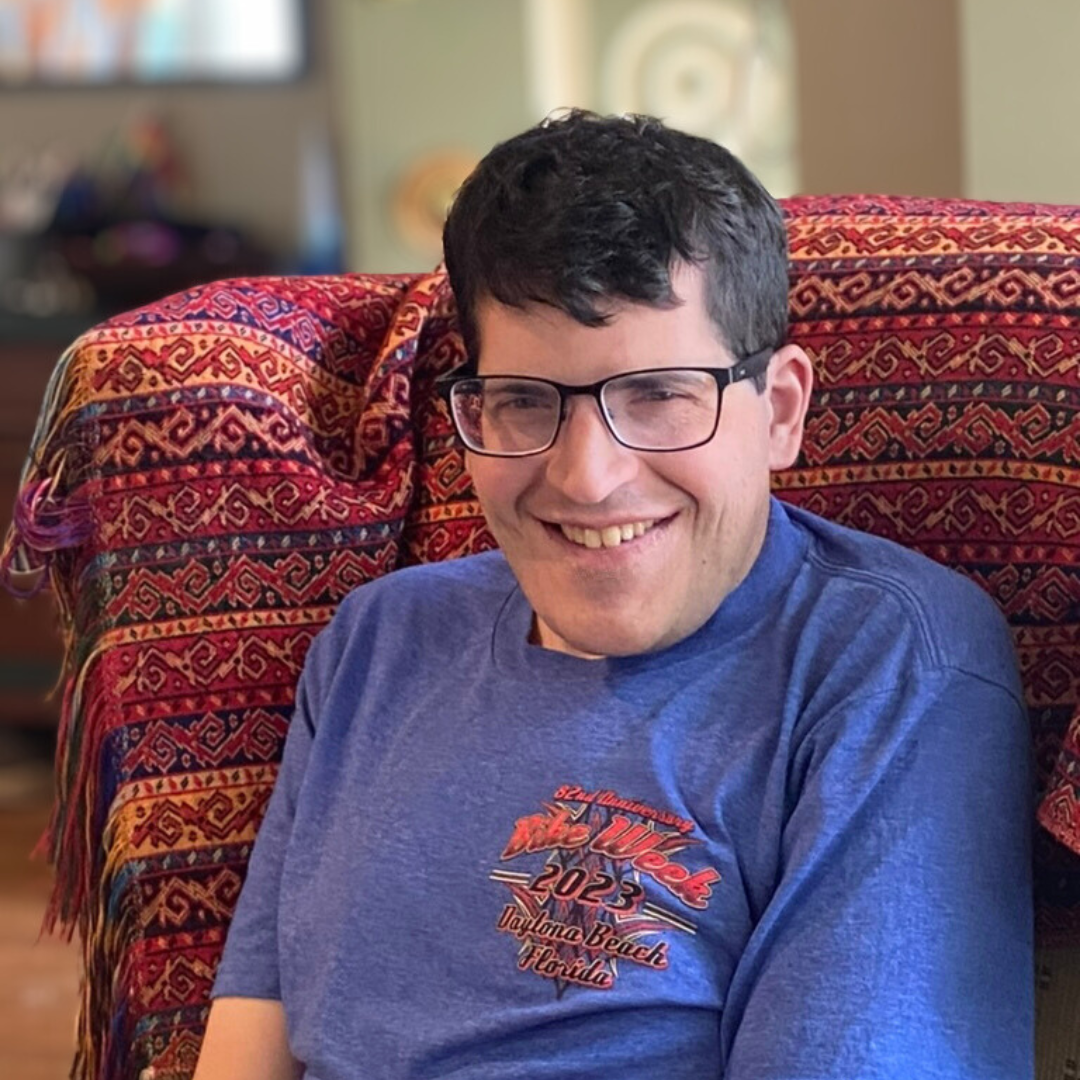
I Want to Get to Know You
As I am getting my son ready for bed each night I like to put some gentle music on in his room. Sam loves melodic tunes, familiar voices, songs that soothe.
For those who don’t know him: Sam is 35, non-verbal, exclusively tube-fed since he was a baby, severely limited from birth both physically and mentally. He learned to walk with a walker by about age 5, but by 15 he had fallen too many times and was afraid to stand up unless supported by someone. He communicates some needs and preferences with gestures and vocal utterances, and he also effectively expresses enthusiasm and protest. He confers winsome smiles and initiates hugs when he feels like it. If something is interesting he moves his wheelchair toward it. If it’s not interesting he propels himself away. I think he understands that he is dependent. He trusts us, his parents, and trusts those others who regularly occupy his time, whether as caregivers, close relatives, or friends. He clearly understands love. He clearly fears certain potential risks and is especially fearful of falling when he is briefly on his feet to transfer from one situation to another — wheelchair to car, for instance. These limitations are the reason Beth and I are the ones who prepares his bedtime medicines, get him into his nightwear, and tuck him in as his favorite gentle music plays quietly in the background.
It’s late September, 2025. Last night we were listening to Anne Murray as I was getting him ready for bed. And the song we were hearing as I pulled the covers over him before turning off the light, was “A Love Song.”
For those acquainted with Anne Murray, it’s the song that begins:
There’s a wren in a willow wood
Flies so high and sings so good
And he brings to you
What he sings to you
Like my brother, the wren and I
Well, he told me, if I try
I could fly for you
And I want to try for you, ’cause
I want to sing you a love song
I want to rock you in my arms all night long
I want to get to know you
I want to show you the peaceful feeling of my home…
For those not acquainted with Anne Murray, well, this is the sort of stuff she sings.
As I was reaching to pat his head before turning off the music, I heard myself quietly singing along with the refrain, and one line stopped me short: “I want to get to know you” echoed across the canyons of my consciousness. I let the song play out. Then I stopped the music and said, as I always do: “Good night, Sam. We love you.”
I have seldom, even in Sam’s lifetime, been moved to tears. But, for me anyway, there was a message from God last night in those seven words, “I want to get to know you.” For, even though he’s been in the core of my own life since the day he was born, and even though I’ve often wondered what he’s seeing — (he has “cortical visual impairment”), what he’s thinking, whether he hurts somewhere or is thirsty or hungry or lonely, I hadn’t, until last night, considered that it would ultimately be granted to me, by the grace of God, to fully get to know him. For — once we have both left this physical world, I, in the fullness of my time and he, in his — he will surely be able to tell me what it was like to be Sam.
It came over me that those who doubt the existence of God have no explanation for the roots of love. Error-prone as I am, how can I treat Sam with such tenderness and such longing to get to know him if there is no God, no divine origin of love? It would be a cruel creator who would let us yearn so much and not offer fulfillment. The words of Jesus in Luke 11:11-13 came to mind as I stood in the darkened house, outside his bedroom door, wiping my cheeks: “And what father is there among you, if his son asks for a fish, will give him a snake instead of a fish? Or if he asks for an egg, he will give him a scorpion? If you who are evil know how to give good gifts to your children, how much more certainly will your heavenly Father give the holy spirit to those who ask him?”
Rarely has Sam spoken in my nighttime dreams, and when he has, it has been only a word or two. On the night of December 26, 2021, though, he spoke much more, and it tore my heart out. In a dream that night, Beth and I were supporting Sam as he slowly and awkwardly walked between us. We began climbing the five front steps to the little house we owned before Sam was born. We had barely started upward when we realized there was a large, noisy, demanding crowd on the small front porch, their attention turned toward something inside.
There was no explanation in the dream for the presence of such a group, and whatever they sought, it was suddenly no longer inside the modest little home. They all stampeded down the stairs in pursuit of the attraction they sought, and they ran us over. The abrupt rush quickly passed, but the three of us, Beth, Sam, and I, were trampled.
In the aftermath Beth and I picked ourselves up and brought Sam to his feet. Gushing tears from the pained face of one who knows too well how it feels to be pushed aside, ignored, and left behind, Sam cried out: “I try so hard, to understand, to keep up, to do what everyone wants me to…” — and that’s where that mercifully brief nightmare woke me up.
I have seldom taken the trouble to put a dream into writing, but I quickly did so with this one and I still have that note. For, that day back in 2021, I understood that I’d had a glimpse into Sam’s humble, quiet spirit.
Last night, though, after hearing the lyrics, “I want to get to know you,” I had what I felt was a promise. Not in this lifetime, but in that realm that some call the afterlife — in Paradise, in the our spiritual presence before God, I will get to know Sam. Perhaps I’ll get to know him as if I had lived inside his struggling, tortured body, as if I had felt the hope in his wishing heart, and as he has seen me, his father, through his flawed vision.
Sam, to you I say: In this life I can only imagine what it’s like to be you. In the next, I trust I will truly get to know you. It’s not what I want, though, that matters. I believe that you will get to know what it might have been like if you could have lived in this world free of the bonds of KAT6A syndrome. You deserve that much from the God who created love.
KAT6 Clinic Opens at Boston Children's Hospital
Major Development: A KAT6 Clinic Has Opened at Boston Children’s Hospital
We’re excited to share that a new multidisciplinary clinical program for individuals with KAT6A and KAT6B is now open at Boston Children’s Hospital, led by Dr. Olaf Bodamer and Dr. William Brucker. This clinic will serve as a true medical home for families, offering coordinated care across specialties.
The KAT6 Foundation is proud to have helped fund the development of this program, made possible through the generosity of our donors.
As the team continues organizing the clinic, families who are interested in care are encouraged to contact rarediseases@childrens.harvard.edu. This inbox is monitored several times a day, and families can expect a response within 24 to 48 hours. After reaching out, families will receive an intake form and the opportunity for a brief informal meeting to discuss expectations. Appointments for an initial evaluation are available on a regular basis with Dr. Brucker and/or Dr. Bodamer.
In addition to patient care, the clinic will gather natural history data and collect biospecimens for the IRB-approved KAT6 biorepository, which supports ongoing biomarker discovery. The clinicians will also continue collaborating with research partners such as the Serrano Lab at Boston University.
For appointments or additional details, families can reach the clinic coordinator at rarediseases@childrens.harvard.edu
300 Longwood AvenueBoston, MA 02115

Empowering Families Through the Empowered Grant
"Wilder has done so well with the therapies she has received with the help of the Empowered Grant!" KAT6A and KAT6B syndromes are a pair of rare genetic variants that can cause a spectrum of health complications, impacting those diagnosed to varying degrees. As a foundation, we strive to spread awareness and advance research surrounding these syndromes. Part of this mission is fostering a strong community that supports individuals diagnosed and their families.
However, while essential and irreplaceable, support alone is not enough to address the wide range of complications many individuals face. Therapies and accessibility equipment—among other forms of treatment—allow individuals diagnosed with KAT6A and KAT6B to experience life more fully and with greater ease. Unfortunately, the more impactful the solution, the higher the cost—expenses that not everyone can afford.
Empowered Grants provide individuals diagnosed with KAT6A and KAT6B the funding needed to purchase assistive equipment, treatments, and technologies that may otherwise be out of reach.
Take Jack’s family, for example. While society has become increasingly accessible, there is still much work to be done—especially in historic areas where equipment like Jack’s wheelchair can be difficult to maneuver.
With help from the Empowered Grant, Jack’s family was able to purchase a portable ramp that has allowed them to take Jack into shops and restaurants with ease. Jack’s mother, Elyse, explains, “Purchasing and using the ramp in public has not only helped us, but helped many others, as the ramp has encouraged local business owners to purchase their own portable ramps for public use!”
Families have also used the grant to address more specialized needs. For example, David Exl explains that his daughter, Ella, was diagnosed with KAT6A, “which affects both her mental and physical development,” and “CVI (Cortical Visual Impairment), a visual processing disorder that makes it difficult for Ella to interpret visual stimuli.”
Using the Empowered Grant to fund Ella’s physical therapy, Exl shared that “a major milestone came in the fall of 2023 when she started crawling—it was the first time she could move around on her own.”
In addition to medical treatments, meaningful social connections have proven instrumental in the lives of KAT6 families. The Empowered Grant also supports these connections by helping families—like Siahna Anderson’s—fund special programs such as summer camps.
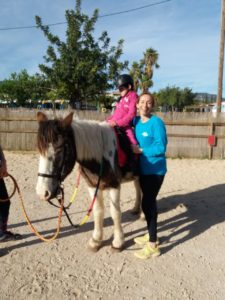
According to Shannon Anderson, Siahna’s mother, at “Adams Camp—a camp designed specifically for kids with special needs—” Siahna “gets to experience camp activities such as swimming, canoeing, horseback riding, summer tubing, shopping, and overnights with friends.” She also receives therapies such as speech, music, occupational therapy, physical therapy, and art therapy.
These programs offer individuals with KAT6 a sense of belonging and normalcy that may be difficult to experience otherwise. Living with any condition can be scary and isolating, but the opportunities made possible by the Empowered Grant can ease that burden through new experiences and meaningful connections.
Backed by our generous donors, we have awarded more than 120 Empowered Grants to KAT6 families around the world. Whether for medical equipment or specialized therapies, this funding provides individuals access to essential resources tailored to their unique needs. The KAT6 Foundation remains deeply committed to supporting our community through Empowered Grants—and the life-changing opportunities they make possible.
Learn more about how to apply for an Empowered Grant to support your child here.

2025 KAT6 Foundation Newly Funded Research Projects
We are pleased to support eight new studies advancing our understanding of KAT6 syndrome.
These projects address disease mechanisms, model development, potential therapies, and biomarkers—laying critical groundwork for clinical trials.
1. Engineering novel genetic tools to unravel the complex KAT6-disease phenotype
Chief Investigator: Effie Apostolou, PhD
Institution: Weill Cornell Medicine, New York City
Dr. Apostolou’s team is working to create a stem cell genetic model which will allow them to control the amount of KAT6A and KAT6B proteins available in a cell. This will allow them to see how different amounts of these proteins affect cell development and highlight future potential therapeutic targets. The group is committed to making their model available to the broader research community. (This study is fully funded by an anonymous donor.)
2. Patient-specific neurodevelopmental models for KAT6B mutations
Principal Investigator: Valerie Arboleda, MD, PhD
Institution: David Geffen School of Medicine, University of California, Los Angeles
This study leverages patient-derived induced pluripotent stem cell (iPSC) lines to investigate how specific KAT6B variants contribute to the phenotypic divergence between Genitopatellar Syndrome (GPS) and Say-Barber-Biesecker-Young-Simpson syndrome (SBBYSS). Brain-like cells grown from patient samples will help researchers understand condition-specific development and open the door to personalized therapies.
3. Neurobehavioral differences in early- and late-truncating KAT6A mouse models
Principal Investigator: Valerie Arboleda, MD, PhD
Institution: David Geffen School of Medicine, University of California, Los Angeles
Dr. Arboleda’s team is creating new, KAT6A variant-specific mouse models to study how different types of KAT6A variants affect brain development and behavior. Based on data from their lab, they will test therapies to see if it can help improve symptoms in mice with severe KAT6A mutations. This study brings us closer to testing treatments that target the specific effects of different mutations in people.
4. Biomarker discovery in KAT6A for translation into clinical trials
Chief Investigator: Sarah Donoghue, MBBS, FRACP
Institution: Murdoch Children’s Research Institute (MCRI), University of Melbourne, Melbourne
This project seeks biomarkers in blood and brain tissues to further understand how cognitive function develops in KAT6A with the hope that we will be able to use this information to measure disease progression and treatment success. This work is building on multi-Omic work that we are doing in the lab to characterize KAT6A models of mice and KAT6A human cortical neuron experiments. We are hoping to understand the impact of KAT6A on brain function in mice and whether carnitine treatment improves this, paving the way for future human trials. Together, these studies will help get us closer to starting clinical trials in people with KAT6A syndrome.
5. A multidisciplinary clinical program and identification of a metabolomic profile in KAT6A/KAT6B conditions to inform clinical trial readiness
Co-Investigators: Olaf Bodamer, MD, PhD andWilliam Brucker, MD, PhD
Institution: Boston Children’s Hospital & Harvard Medical School, Boston
Dr. Bodamer is launching a new clinical program for patients with KAT6A and KAT6B syndromes at Boston Children’s Hospital. The team will collect detailed health data and samples from patients to better understand the natural course of these conditions. They’ll also search for unique biomarkers that could help doctors know when a treatment is working. This project combines high-quality patient care with research aimed at preparing for future clinical trials.
6. Epigenetic landscapes and gene regulation in KAT6 disorders
Co-Investigators: Maria A. Serrano, PhD and Gustavo Mostoslavsky, MD, PhD
Institution: Center for Regenerative Medicine & Boston University Chobanian & Avedisian School of Medicine, Boston
This research examines how KAT6 mutations affect gene regulation in brain, gut, and blood cells. The team will use an advanced method to see how these cells’ “epigenetic landscapes” (chemical markers that control gene activity) are different from healthy cells. It may also identify blood-based biomarkers for easier monitoring of disease progression and treatment.
7. CA3 neuronal development in KAT6A and KAT6B patient-derived iPSCs
Principal Investigators: Thomas Durcan, PhD, Faïza Benaliouad, PhD and Gilles Maussion, PhD
Institution: Neuro: Montreal Neurological Institute-Hospital & McGill University, Montreal
Focusing on the CA3 hippocampal region linked to memory, this study uses patient-derived stem cells to uncover how brain cell development is altered in KAT6 syndromes. The goal is to find points for therapeutic intervention.
8. When Proteins Go Wrong: Unravelling the Impact of KAT6 Variants on Protein Structure and Function
Principal Investigator: Shabih Shakeel, PhD
Institution: Walter and Eliza Hall Institute of Medical Research
This project is focused on characterizing the effects of different KAT6A and KAT6B mutations on protein structure and important protein functions such as binding with protein partners and acetylation. They will do this first characterization by isolating the proteins and studying them in test tubes. Dr. Shakeel’s team will then see how these changes in function lead to downstream changes to actual cells. (This study is fully funded by an anonymous donor.)
MCRI is Seeking Participants for New KAT6A Research Study
Biomarker discovery in KAT6A for translation into clinical trials
For KAT6A syndrome and other neurodevelopmental disorders, researchers are starting to understand the dysregulated cellular processes affecting neurons and their supporting cells. The Chromatin Disorders Research Team at Murdoch Children’s Research Institute is currently using a mouse model, alongside human cortical neurons to study gene expression and metabolomics KAT6A syndrome, in collaboration with Professor Anne Voss at the Walter and Eliza Hall Institute of Medical Research. This work is being led by PhD student Dr Sarah Donoghue and supervised by Professor David Amor and Professor Paul Lockhart. The goal of this project is to understand the differences in brain development that occur in KAT6A syndrome, and to identify biomarkers that may show response to treatment in clinical trials.
The team is looking to extend their work on blood biomarkers in KAT6A mice to children and adults with KAT6A syndrome. In this project, they will measure a range of molecular compounds in blood samples from human participants with KAT6A syndrome, using untargeted metabolomic and proteomic analyses. They will compare the plasma profile of 50 KAT6A syndrome participants to the plasma samples of 20 participants without KAT6A syndrome. The aim is to identify biomarkers that are detectable in the plasma of participants with KAT6A syndrome, with the hope that these can be translated for use in clinical trials, as an objective measure of treatment efficacy as the community proceeds to clinical trials.
For more information about this research, please contact Sarah Donoghue at sarah.donoghue@mcri.edu.au.
Personal Stories
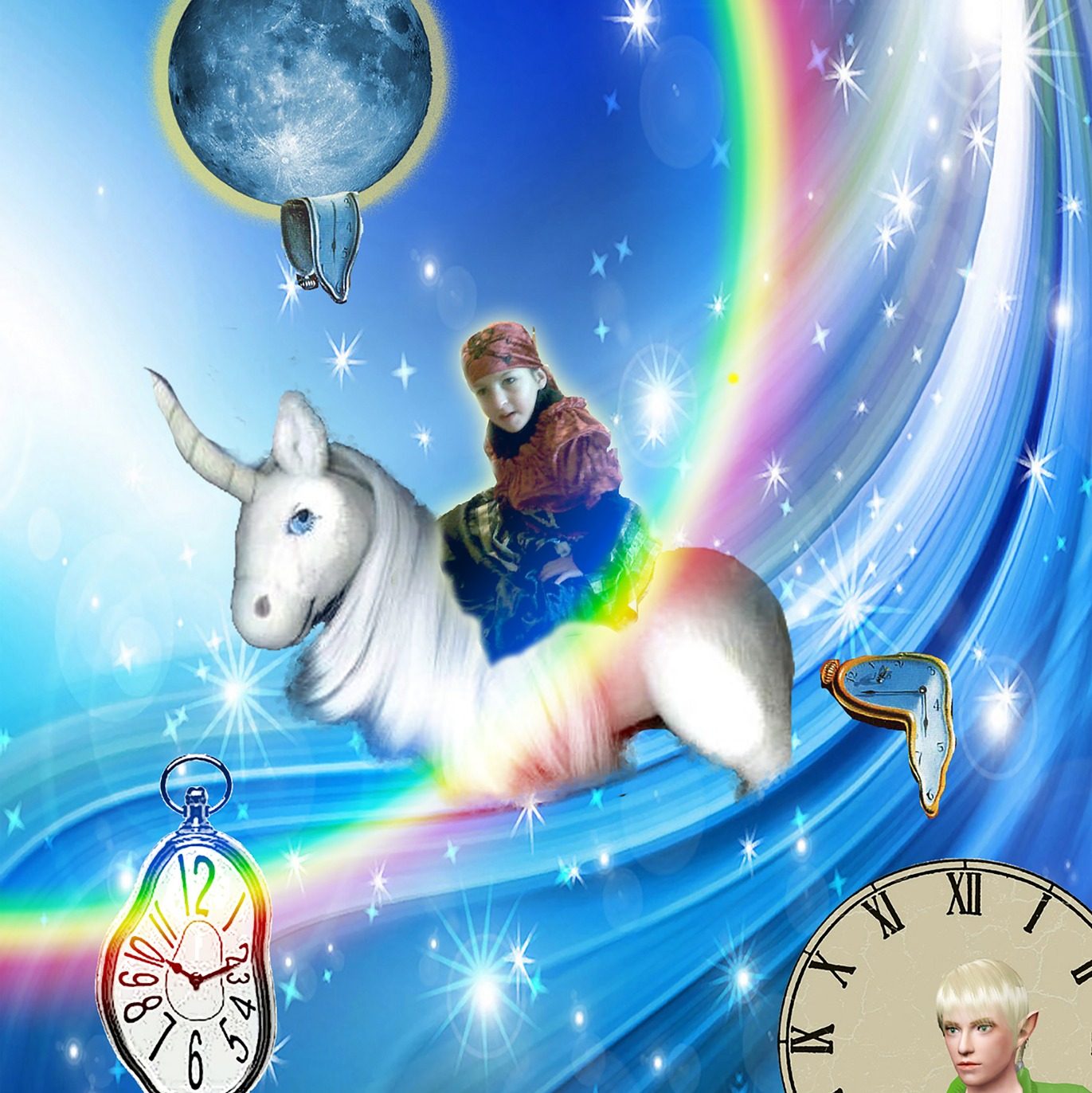
Victoria: Peaceful, Musical and Always Cheerful
Our daughter was born on the 1st Februrary 2009 in Son Espases University Hospital, Palma, Mallorca.
She was a 36- week baby, very tiny for her age since it has been diagnosed with slow growth in the last months of pregnancy. She took long to be born and was immediately taken to intensive care were she spent the first 50 days of her life.
There, she was taken extreme and loving care by devoted doctors and nurses and we discovered how dedicated this job is. We took her home on Father’s Day ( 19th March), so as we took a bed sheet from hospital, as advised, it was a lovely little present.
We will always remember her regular visits for checks-ups and tests during the first year of her life. She felt such at home in every hospital visit that her face changed every time we entered the foyer and she smelt the care she had been receiving so far.
First days at home were not easy, she had to take many pills to regulate her kidneys and heart function and took a special milk in the bottle for she was allergic to the milk protein.
Little by little our little warrior took forces and started to eat bigger quantities and feel more relaxed. It took some years and a special therapy ( Votja ) to stop her screaming constantly and sleep tight, also to open her hands and relax since she suffered from muscular hypertonia and was always nervous and not connected to this world. For the first year in her life she was folded on her hips and spine as a ballerina in the shape of a ball.
She has had three operations and is waiting for a fourth one to be done on her spine since she has severe scoliosis. Although these operations have contributed enormously to a healthier life style,they have been the scariest waiting time in our lives. First operation, at 6 months, was a heart operation to close her persistent ductus. Second operation was to contribute to better vision ( she was not able to look completely from both eye sides) and third on her teeth (cavities and hygiene).
At one year and a half she went to the same private nursery school as her brother. She had a lovely time there with babies who were about 6 months younger than her. She enjoyed story telling , celebrations and nursery rhymes.
Later on she attended a special needs unit in a state nursery school and at four years entered the special needs school she goes to now. We are very pleased with the school and give thanks for her progress to all speech therapists, physiotherapists , teachers and other professionals that are on her side day by day. She feels really happy there, it takes her long to wake up every day, but by the time she gets to school she starts smiling and forgets it all.
Victoria is a loving, cuddling, cheerful girl who loves music, swimming, horse therapy. She loves her brother, her family, going out for a walk, attending or having parties, swimming, embraced dancing and being on a swing. She loves speeding especially on the motorway or when taking off). She has improved a lot in the last year and is much alert, but she is dependent 100% on an adult in every day tasks since she cannot walk or speak.
She’s being taught to feed herself, she can mount her special chair with help and switch on/off lights. At present we are focusing on walking and improving speaking. As for the first, she is not able to stand, but has the walking pattern and is eager to walk. Related to speech therapy we are using an alternative system of communication (Grid 3) with the help of an eye tracker (Tobii 4C).
She was diagnosed with KAT6A about 3 years and a half before. We do not know where she can get, but have faith in the future and, as a family, want the best for her.
She’s taught us many things such as the power of love, being patient and to be positive and smile to the future.
Mi reloj tiene un duende“Lo mismo que me sorprende que un oficinista de banco nunca se haya comido un cheque, asimismo me asombra que nunca antes de mí, a ningún otro pintor se le ocurriese pintar un reloj blando”.(Dalí sobre su cuadro ”La persistencia del Tiempo”)Hay una exagerada tendencia a creer en la ciencia, sobre todo desde que la gente comprueba que la aparatología es maravillosa. Antes te sometías a una colonoscopia en vivo y, además de la escena, estaba, aterrador e insoportable, el dolor con sus garras. Ahora te haces una siestecita y lo primero que aparece entre las brumas de la ante vigilia, es el rostro sonriente de tu médico, que ya es un amigo.Georges Braque, el pintor, decía: “La ciencia está para dar seguridad, el arte para turbar”.La ciencia, a palo seco, se convierte en una fábrica, pero de repente, aparece alguien como Steve Jobs y es como si entreviéramos la silueta de Leonardo. Entonces la ciencia despega, porque hemos añadido el genio.El físico estadounidense David Wineland y el francés Serge Haroche ganaron el Nobel de Física 2012 por “sus innovadores métodos experimentales para la medición y manipulación de sistemas cuánticos”. Su trabajo ha permitido conseguir relojes mucho más precisos y dar importantes pasos en los ordenadores del futuro.¡Aja!…eso si que le va a gustar al personal. Nos hemos pasado toda la historia de la humanidad tratando de ser los autores del cambio de su curso, o sea de manipularla.Todos imaginamos que un reloj diseñado por Wineland &Haroche, en la vida frenética que llegamos será fantástico: si te quedas sobado una mañana, y al llegar al Metro el tren ya ha partido, entonces: toque al reloj, el tiempo retrocede y tu pillas el vagón tranquilamente y encima te sientas.Aplicado a las citas es genial. Quieres seducir a es@ chic@, y en el japo de moda no hay mesa. Disimulas y ya estás bebiendo la horrible cerveza aguada que es lo peor de los Restaurantes Japoneses. Asimismo, podremos volver atrás para callar las palabras que no quisimos decir, o ver la vida desde el lado del otro (muy recomendable); conocer a los parientes que murieron antes que nosotros pudiéramos tener uso de razón; dar ese beso congelado, pedir esas disculpas que nunca llegamos a dar… Y ¡tantas cosas!.Sin llegar a eso, ni a los relojes blandos de Dalí, pura metáfora, yo estoy convencido de que en mis relojes habita un duende.El mío es siempre el mismo. Si me pongo uno u otro reloj, le obligo a cambiar de habitáculo, y es evidente que no en todos se encuentra igual, porque adapta las horas que acaban siendo mi tiempo, según le apetece. Por eso tengo días en los que los minutos en su devenir, se arrastran como pesadas sombras que recorriesen largos pasillos de mansiones victorianas. A veces, todo va muy rápido y sincopado pero en algún momento se encasquilla. Es un tiempo seco y tartamudo, de cartón y poliestireno expandidoTengo muchos relojes porque me gusta el diseño, pero ni el más caro supera los 100€. Uno de los más queridos me lo regaló ella: Victoria.Creo que lo debió hacer porque llegaba siempre tarde a sus fiestas de cumpleaños. Se trata de un reloj de sobremesa, que parece adecuado para indicarme:– ¡venga!, ¡comienza a arreglarte!La primera sorpresa es que se abre como una lata: tirando de una anilla como si fueras a merendar pâtè con pan de molde, aparece la esfera convencional de un reloj vintage. Luego resulta, que además es imantable, o sea que se adhiere a superficies metálicas para que puedas llevártelo y fijarlo.No sé si serán imaginaciones mías, pero es el favorito de mi duende. Creo que es donde hace la siesta cuando yo la hago, y duerme en las horas de mis sueños…Con este reloj, los días se deslizan como cucharadas de miel en una primavera fría. Las horas caen como pétalos de flor de almendro; los minutos como copos de avena; y los segundos como gotas de lluvia breve, un perfume inventado por mi abuela al que llamaba “Lágrimas de Abril”.De noche ese reloj hace ruiditos como si el duende se levantara a comer rosquillas de anís, a hacer pis, o a mirar si duermo. Pero ahora el que no duerme soy yo, que miro si el duende da señales de vida y…no sé… miro si tiende la colada o sale a fumar a las 3, sentado en la manecilla pequeña, o cosas así.De repente, las manecillas, entonan un tic tac tic tac que se asemeja a una carrerilla que viniera de lejos. En ocasiones, ese ruidito rítmico, va “in crecendo”. No es mi duende porque él es discreto y silencioso; pero como Victoria asiste a clases de hípica, pienso si vendrá ella a verme, al trote de su querido caballo, y me pegunto si llegará, de carnaval, gitana de sol y luna con la bata de cola, con alegría de cascabeles en las crines de su montura, y de lunares rojos en sus zapatos de baile, que llevan prendido con zambra, el taconeo embrujado del flamenco.Taca,tacataca ¡tac!.Jaime Roig de Diego
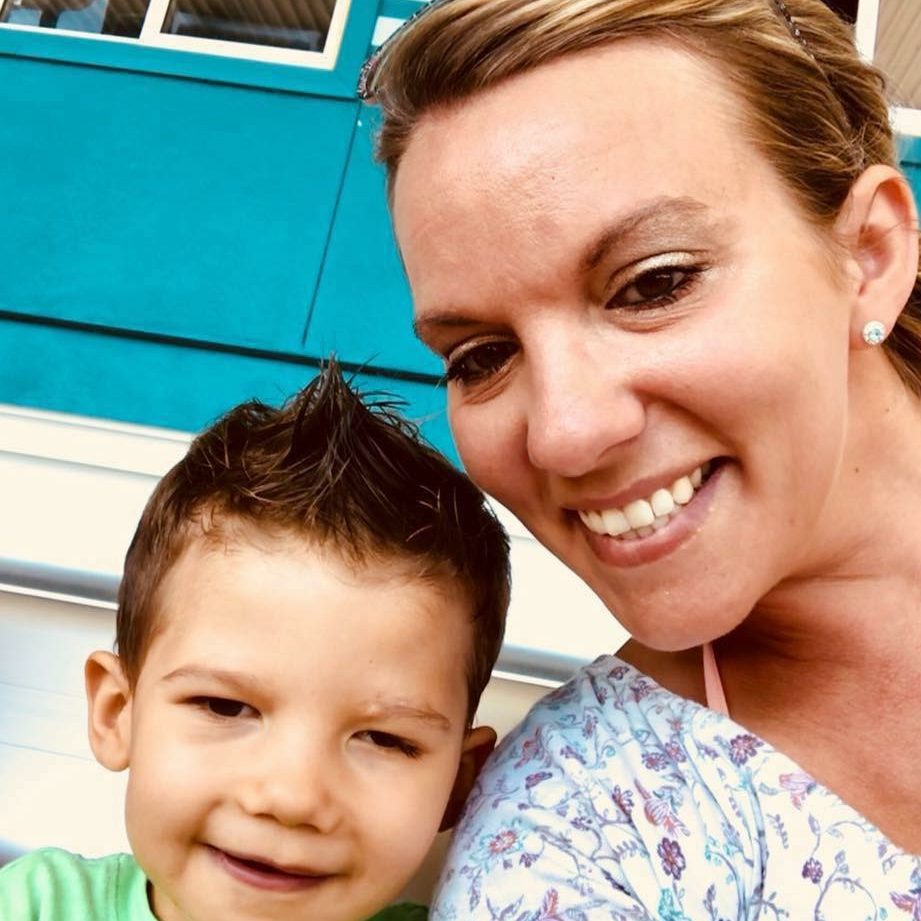
1-2-3 Go Camo!
Camden’s journey began twenty-four weeks before taking his first breath of fresh air. After a long family move from Kentucky to Washington State, it was brought to our attention during an ultrasound that Camden had a congenital heart defect known as Tetralogy of Fallot. We knew that within months Camden would need to have open heart surgery to correct the defect. Our family had no idea that this would only be the tip of the iceberg for years to come.
Camden Rau was born on February 9, 2015 via emergency C-section at Madigan Army Medical Center. Immediately after birth, he was sent directly to the NICU. When I followed Camden’s medical entourage into the NICU, I noticed something very strange. Camden’s head was extremely tall and elongated while having a very obvious skeletal deformity from his forehead to the back of his head. It was determined that he had craniosynostosis, which is the premature fusing of the bones in the skull. With these two serious issues identified, the Geneticist told us there was a very good possibly Camden had a genetic disorder, but it was too early to tell which one based on symptoms alone. So we waited.
One month later, Camden had his first open heart surgery at Seattle Children’s Hospital. He had a very rough recovery and spent approximately five weeks in the Cardiac ICU. Once he recovered, doctors then began to focus on Camden’s other issues. With sights set on a very evasive skull surgery, doctors agreed that Camden needed a G-Tube to eat because he was failing to consume enough calories by mouth. They also determined he would need to have another heart surgery to close a hole before the craniosynostosis repair to reduce the risk of brain damage and stroke. At nine months old, Camden finally underwent a full craniosynostosis repair from ear to ear to fix the shape of his skull and allow his brain to grow appropriately. After the skull repair, Camden’s blood oxygen levels could not stabilize and he required oxygen until he was approximately eighteen months old. We continued to wait and search for answers.
After the surgery, our family moved once again to Cleveland, Ohio. Camden was almost two. He underwent two eye surgeries in Cleveland to fix his droopy left eyelid to prevent him from going blind. We are extremely grateful that we moved to Cleveland for that short time because that is where we were able to conduct our genetic testing. While waiting for the results, the Army relocated our family to San Antonio to receive more efficient health care for Camden. During the move from Cleveland to San Antonio, we found out that Camden had the KAT6A Genetic Disorder. Our search for the cause was over, but what were we supposed to do now? There was very little research and doctors told us very little because they didn’t know anything about it. It’s at that point we were able to connect on the KAT6A support group on Facebook to get some answers.
This was such a relief to finally understand what issue has caused our son to experience all of these conditions, surgeries, pain, and suffering. Finally! Some kind of proof to show doctors who made us feel like terrible parents by saying our son was failing to thrive, accusing us of not feeding him enough, and constantly bringing up the percentile chart for height and weight to emphasize we are not doing our job. It explains why our son has never spoken a word and why there is a good chance he never will. It explains why he has so many physical issues. It explains the cognitive delays. It explains the brain damage. It explains why he is so tiny. It explains the constipation. It explains the poor muscle tone. It explains everything.
Just because we have come to terms with reality and have some answers does not mean we have given up hope. Camden is the definition of resiliency; bouncing back from everything life has thrown his way. Every day we wake up thinking this might be the day he says a word, or the day he can finally eat a normal meal, or that he will somehow overcome a physical obstacle he’s been dealt.
Camden has been the biggest blessing in our lives, and he has touched the lives of so many without even saying a word. He teaches us to be patient, loving, and selfless. He lights up every room that he is in with his amazing smile, caring nature, and his personality. He loves his mom, dad, big brother, and dogs. He has to emulate everything his big brother does, and then some. He loves sports, balls, trucks, cars, hitting keys on the piano, and watching the whales and fish at Sea World. He walks on his own, but he requires ankle braces to stabilize. He loves to jump on trampolines. He utilizes speech therapy, physical therapy, and occupational therapy each week to help overcome his deficiencies. He does communicate vaguely by pointing and using basic sign language skills, and he eats strictly through a feeding tube.
Recently this past week, Camden was forced to undergo yet another open heart surgery to receive a Pulmonary Artery Valve replacement. This surgery was supposed to happen in his late teens or early twenties, but his right ventricle was four times the normal size and the valve was leaking forty percent of blood being pumped to his lungs. Unfortunately, this will not be his last open heart surgery. The valve replacement typically only lasts two to ten years, but we will always expect the worst and hope for the best. He also had to undergo another operation today because his surgical site was infected, but we are looking to leave the hospital within a week or two.
Thank you for taking the time to read about my son.
We are honored to be Camden’s parents and very proud of everything he has accomplished so far in such a short amount of time.
We are happy to be a part of the KAT6A family.
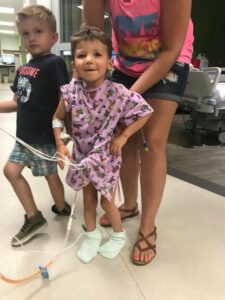
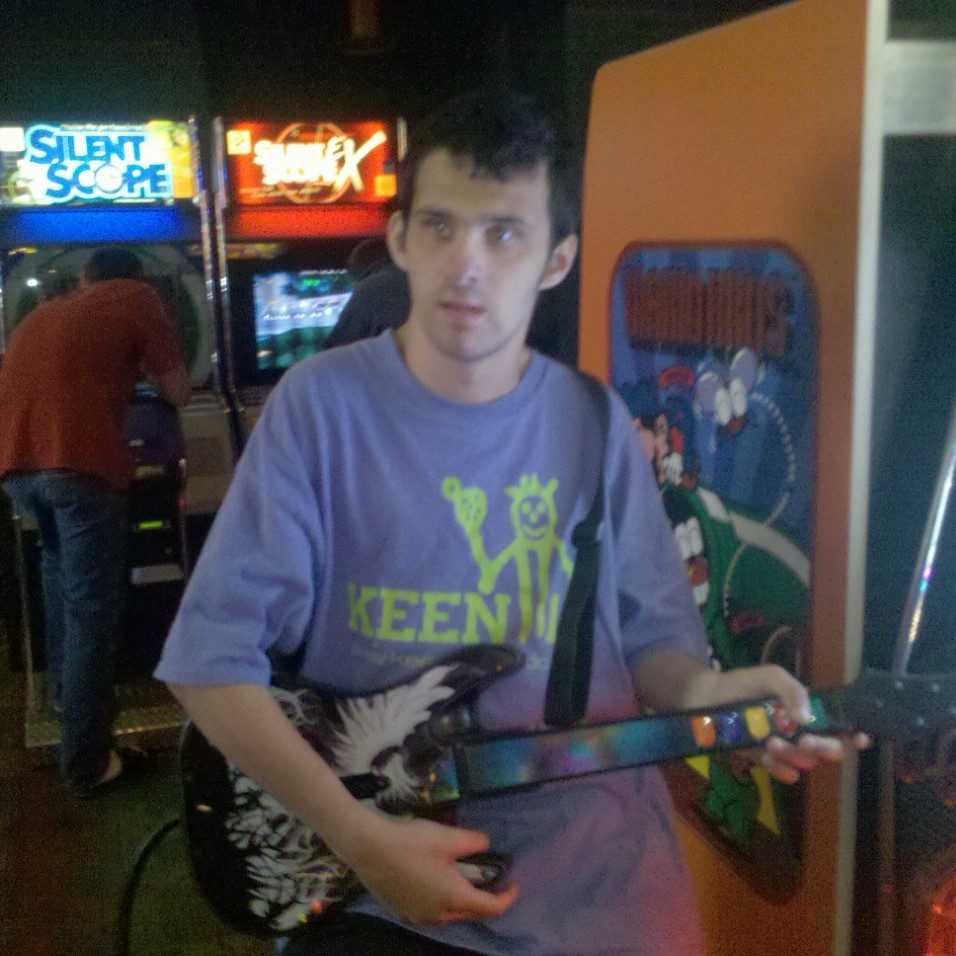
Warren's Story
Mothers Day 2018.
33 years ago I was about to give birth to my first child, who ended up being born on Memorial Day, 1985. I originally went into labor two days earlier, but a trip to the hospital with irregular contractions resulted in returning home “to wait” Two days later, still no regular contractions, almost two weeks overdue and exhausted, it was decided to induce. I thought at that time parenthood would be the easiest job I ever had. First mistaken notion.
“Warren” came out after a difficult delivery, very depressed. His first Apgar was a 6, but his second a 9. They rushed him off to the nursery and had the neonatologist follow his care. He was “floppy”, had a huge startle reflex, was very sensitive to touch, would nurse for a few minutes and then fall asleep, but after 3 days they released him as an “essentially healthy infant”. I thought everything was fine. Second mistaken notion.
He was a challenging baby. He never, ever slept more than two hours at a time. Never nursed well, we had to supplement after a week when he continued to lose weight after coming home. He had terrible reflux, would spit up through his nose; he was slow with motor development. The startle reflex continued. If I walked from a dark room to a lit one with him, his whole body reacted. Still, he was sweet natured (still is) and was gaining weight and at 3 months the doctor said he was doing great.
Then he had his first DPT shot. That night his fever hit 105. He laid on my chest for three days and hardly moved. At my pediatrician’s insistence he never received any part of the “pertussis” vaccine again (actually none of my children did). I don’t think the vaccine caused any of his disabilities – but maybe opened a door to let what was lurking there in a bit sooner, and more strongly. This is just my opinion, and most professionals will tell me I’m crazy, but they weren’t there.
When Warren wasn’t walking by 18 months, and barely crawling, we started our first round of visits to Children’s Hospitals. There I was told – and I swear to God this is the truth – “You definitely want to go through genetics because you wouldn’t want to produce another one like this” and at the next visit – “don’t fret, I have parents of gifted and talented children who don’t know how to raise them either”. Third mistaken notion – the experts know best.
We received the diagnosis of “developmental delay” – Fourth mistaken notion – that delay meant late, but just like an airplane it would get where it needs to go eventually. I did not know it was a euphemism for “we don’t know what is wrong with the child, but things don’t look good, and might never”.
Years go by – we run all the tests, nothing comes back with a reason for the “delay”. We end up with a diagnosis of autism at age three and the pronouncement by many experts that this would never happen again….and so my daughter was born. She was the complete opposite of her brother, walked at 9 months, had words at a year (Warren has never spoken one word to this day). All the doctors and friends assured me she would be fine. And so her two brothers followed. And then she started getting “weird” – perseverating on objects and actions, single words never turned into sentences. At age 4 she also joined the ranks of special education. Side bar here – Emily has been diagnosed with what is very clearly autism – and manifests some bipolar tendencies, but does not have KAT6A – which surprised the doctors. Her brothers are neurotypical and doing well.
Warren learned to walk, for awhile he was successful with limited sign language, but his fine motor skills have always been very poor. I was the only one who understood his signs and they were limited. After two years on baby food he started eating solid food, but to this day, refuses anything highly textured. His weight, even now, is a concern. At 5’8” he has never been heavier than 158, and now is 143 pounds.
Over the years there have been a number of medical problems – he developed aerophaghia – air swallowing. There is no treatment and it can be fatal. But thanks to some wonderful therapists and doctors we got this under control. His motor skills led to a diagnosis of mild CP. He never outgrew his strabismus. But he enjoyed school, became somewhat independent, but the combination of his disabilities meant he could never master his personal care skills independently. He still has toileting accidents occasionally, needs to be fed, dressed, bathed, but he does cooperate and assist with all of these, and he is ambulatory. On the surface, judging by his skills, Warren would seem to be very cognitively impaired. But there have been some things he has demonstrated that clearly indicates his understanding of things is far higher than appears.
And then at age 9 the seizures started. Nothing helped. They were called partial complex seizures and he did not convulse, but it was more than just the staring of absence seizures. Eventually, a brave neurologist tried a new medication that had just been approved in the US, but had been used in Britain for awhile – Lamictal. That, with Topomax, stopped the seizures for several years. But, they did come back, and this time as grand mal seizures. We have tried every combination of medications, and we went through periods of calm, only to have them come back in clusters. Last fall he had a Vagus Nerve Implant, which was a very difficult adjustment, but now seems to be helping. One seizure since January.
We raised all our children at home – under circumstances at times that were harder than anything you can imagine. My daughter’s autism manifested itself with aggression and violence at times, but with the help of incredible staff, and wrap around services, our family stayed in tact.
I had wanted Exome testing done since the first time I heard about it. I wanted to know why this happened to us, and was sure there would be a diagnosis that applied to both Warren and Emily. However, my insurance would not cover it and it was impossible for us to afford. I had applied for the Autism Speaks credit card and charged everything I could so that they would receive 5%. One day I received a phone call that they were sponsoring an Exome study at NIH (around the corner from me) and we would be able to get the Exome testing for free – was I interested? Of course I was. Sign us up! And then they said, if Emily and Warren could not give “informed consent” then they were not candidates.
Mistaken notion 5 – I thought we were all in this together. Bless my dear friend who works for a genetics company who was able to arrange for our family to have the sequencing done for what the insurance would cover. When the results showed that Warren had KAT6A, but Emily did not, it was a blow. Things were just getting rolling with KAT6A and Warren was, and I think still is, the oldest person diagnosed. Many became interested and asked to use him in studies and publications and we readily agreed. Here was one answer as to why this happened, and it wasn’t hereditary, and it wasn’t caused by something I did. All good news.
Over the years I can’t begin to tell you the things my husband and I tried to “find the cure” – some ridiculous, most expensive, all bringing marginal change. Warren to this day is a lovely young man who loves music, movies and pretty girls, but he requires a lot of help. I was warned that other KAT6A families might seek me out to know what the future of their young children would hold. I know what it is like to think that if you keep trying, one day you will find the answer to what will help your child. I have been fearful that if I revealed the extent of Warren’s limitations it would not be welcome information to these families. I have purposely stayed in the background.
But that doesn’t mean I’ve turned my back on things. I confounded a nationwide organization called KEEN (Kids Enjoy Exercise Now) that provides free recreational opportunities to children with severe disabilities. I have served on Boards and Commissions serving the disability community at my county and state level for 20 years. I initiated and chair a Developmental Disability Advisory Committee. My work at this point is devoted to improving the quality of life for the developmentally disabled.
Three years ago Warren and his sister moved into residential settings. They live in side-by-side townhouses ten minutes from our house. They have roommates and round the clock staff. They work and play in their community and we see them every weekend. It is a pretty good life for them, and at age 63 and 71, a blessing for my husband and me to know they will be cared for when we are gone.
But three years ago Warren had a bad fall, broke his femur, and after two months of recovery, had a seizure and another fracture. Now it seems this might be related to the KAT6A – but it also could be the epilepsy drugs he has been on so long. Who knows, but once again, we are trying to see if there is something else we need to do to help him. Thus, this blog, and emails to Dr. Kelley.
When I was asked to write this, I asked what should I write about – I was told tell us about birth on. I know I have given you more than you ever wanted to know, but once I started, I couldn’t stop. I wish you all the happiest of Mother’s Days. Your children are very lucky to have you.
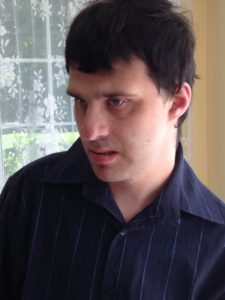
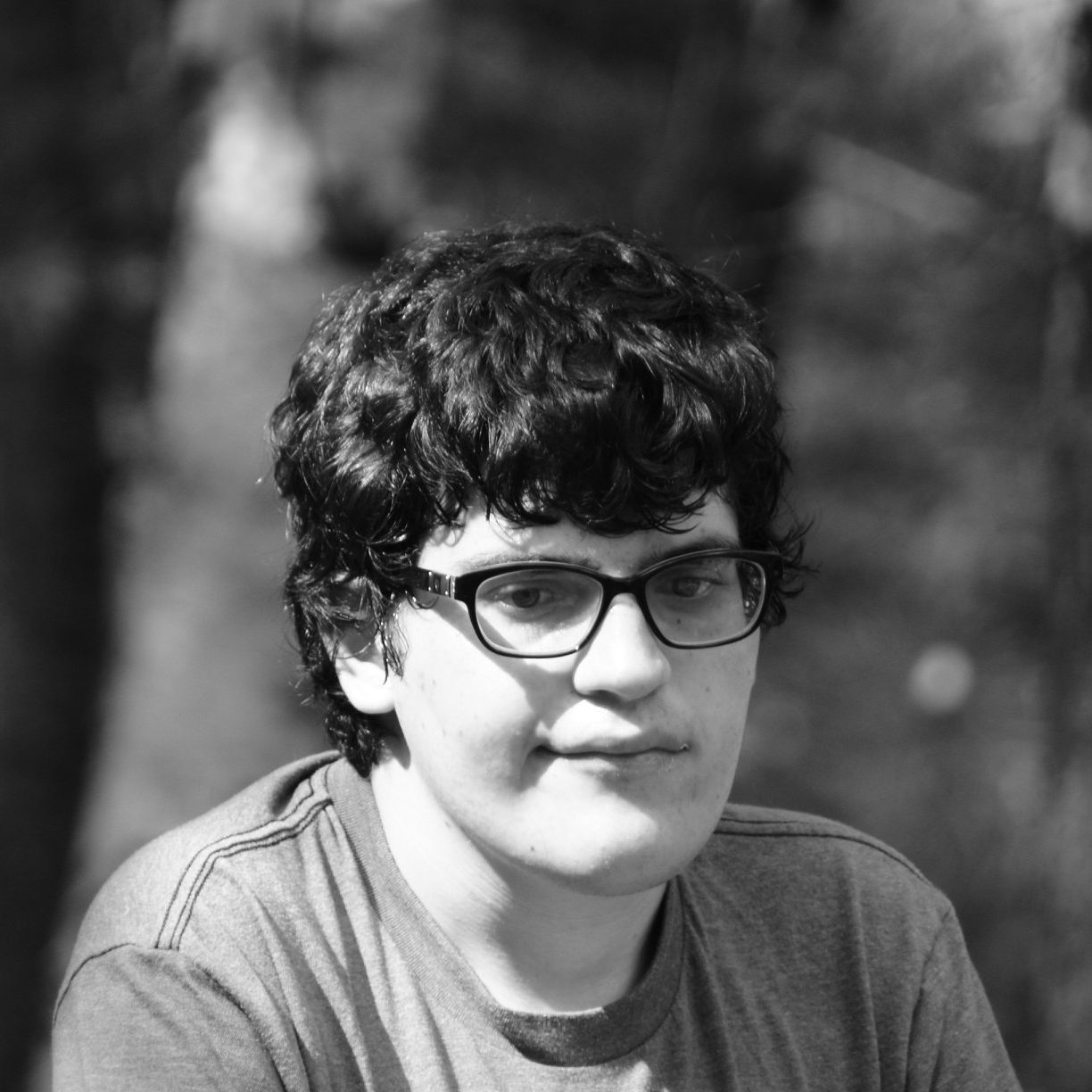
Morning at My House
Sam inspired me to send you a description of his typical morning, in what I imagine would be his own words. I would call it…
MORNING AT MY HOUSE, BY SAM WOODBURY
Here he comes again, this time at an hour past midnight — Dad-with-flashlight. I coughed and the monitor picked it up. That woke him and alarmed him. In the darkness he just bounced off the corner of a table in my room and now he peers at my face. I pretend to be asleep. He stares at me for a second or two longer and then, satisfied, he turns to leave. He turns off the flashlight and trips on the chair at the foot of my bed, grunts, and then he’s gone.
Now it’s 4:30 a.m. and I’m wide awake. A couple of hours to kill before they usually wake up. Let’s see whether I can knock the TV over with a flying pillow — nope. I guess I’ll sit up and slam the Venetian blind against the window frame over my bed. I like the rhythmic Whack! — Whack! — Whack! as it slams back against the window.
Oooh, Mom has her morning face on! She shuffles in and mumbles something about 5:00 a.m. They think I don’t understand time. I understand that it’s never a good time for things I do that make a lot of noise or cause an unexpected load of laundry.
Well, now I’m on the toilet, my walker before me to keep me steady. They — that Mom-and-Dad pair — had a good idea a while back. I need time on the toilet to get my system moving, lots of time. (Do I understand time or don’t I?) But I used to get bored, and then I’d twirl my walker like a dance partner and dent the wall, or I’d twirl the roll of paper and make an impressive pile of softness on the floor. So that Mom-and-Dad pair bought a TV and mounted it on the wall in front of my toilet. Since it arrived, I get to watch Shaun the Sheep, Masha and the Bear, and other stuff they think I’ll like. I can’t speak words, so I can’t ask for SpongeBob directly. At least the TV relieves the boredom of the toilet.
Dad’s turn now in the morning routine. In greeting, he squeezes the top of my head with a large hand. I like that. I try to hug him but he makes me wait until I’m off the toilet. Once I’m up and partly dressed he squeezes me hard and I hug him harder. Then we’re off to deposit me in my recliner chair next to my bed.
I have this secret wish that they’ll both forget the toothbrush today. Mom forgets a lot but Dad usually remembers. Here it comes…! Aaaghhh — kewww — gaaaack!! Mow my mouff if full off faliva and I can’t fwallow!
Well, I do fwallow a trickle of it after a while but I hate it. What is that for, anyway? Next comes breakfast — hooray! I pull up my shirt to expose my G-tube. It’s always the same old gooey slurry that gets poured into the tube, with glops of additives, then portions of what they call “meds” followed by slops of water — (will these people ever come fully awake?) — and now I can relax and watch excruciatingly boring ads for Nutri-System and Humana on the big TV across from my chair.
Mom is sitting at the table in my room now, scribbling in her book — a big binder. She snaps it open and closed, open and closed. She scrawls in tiny boxes on lots of pages. I judge my timing and then I sneeze, just to jump her, and I spray my mouthful of foamy saliva. I can tell she’s impressed by the speed of her response, and I grin inwardly as she goes into action to save the folded clothes in the laundry basket in front of me.
Dad comes back with his plate of toast, meets my high-five, and sits on my unmade bed. I high-five at him again and again so he can’t eat. He calls me Buster Keaton. I know my name; it’s Sam. Maybe “Buster Keaton” means “I forgot your name.”
After toast he walks me to my shower. When Dad does the shower he sings his two favorite songs: Old Man River and Ghost Riders in the Sky. He also likes Cool Water and The Windmills of Your Mind. That last one really describes my mind, but I can’t tell him, so I try to hug him. He doesn’t want a wet hug. I guess these are also my favorite songs, because no one ever sings me any other ones. But you’d think he’d learn something else.
Usually it’s Mom who does the next set of rituals. She sprays my armpits with Holy Odor, makes precise designs in my hair with incantations, and then smears gel on my face and scrapes it off. I don’t know what this all does for them, from the tooth brushing to the face routine, but they can’t live without it. (The feeding I understand because it feels good to me. The rest makes them happy, so I don’t resist. It’s loving, and I get a lot of attention, and I get to slap the water in the sink while mom drives her toy snowmobile or whatever it is around on my face.) Finally someone pulls clothes over me and I can sit down again. Let the day begin!
MY WORLD BY SAM
After my morning rituals, Adria comes in the daytime and hangs out with me. I realize it’s her job, so I try to brighten her day. We go places together, but almost every day she stays home with me for a while and makes me work, work, work. Adria makes me walk a lot. Walking frightens me, and I say so; that is, I groan my loudest when I’m supposed to be walking. She puts a “weight vest” on me and then walks me in circles in my room. I hold onto my walker, wearing that eight-pound vest, and shuffle slowly in a circle. I think: “Does this entertain you? How about you wear this vest and march around for me?”
A couple of times, when I’ve been on my feet, the floor has suddenly come up from behind and smacked me in the back. I have broken my ribs and had a lot of bruises. Since that happened, Adria or Mom or Dad walks behind me with a hand on my back. Dad says: “Go ahead, try to fall. I won’t let you fall.” They have all caught me at one time or another, so I know I’m safe. If someone isn’t right behind me when I’m standing, I just kneel at my walker, then sit and wait.
I fall because I’m a “Jumping Frenchman of Maine.” You can look that one up. My mom’s French Canadian grandmother ran sporting camps in Greenville, Maine. That’s where “jumping Frenchman” syndrome apparently originated. It is related to hyperekplexia, but don’t ask me to spell that. Either way, it’s an exaggerated startle reflex. Surprise one of my senses with a sudden change and I jump out of my skin, as my mom says. All it takes is a flash of light, a sudden movement off to my side, a ‘pop’ sound from another room, or an unexpected touch, and I throw out my arms and legs. Gravity decides what happens next. It is no fun.
About this walking thing. When people come up to me on their own two feet, I think: How do they do that? I could use about four more legs — or maybe not — where would I put them all when I’m in the car, or in bed? How would I put on my pants?
Adria also takes me all over the place in her Ram 2500 monster truck. I can step up into her pickup, or Dad’s truck too, by myself if I can hold onto someone’s shoulder so I won’t fall. Then Adria and I go to my meeting or to my job. On Mondays there is a SUFU meeting — Speaking Up For Us. Since I can’t speak, the president sometimes passes me the gavel so I can pound the table.
I take my job seriously. Two days a week I ‘m the Social Director at Meals-for-Me at lunchtime. Since I’m 100% tube-fed on a liquid diet, nobody is worried that I’ll eat all the cookies or take the last piece of meatloaf. My job is to sit beside one of the old ladies, a different one each time, (they take turns), and hold her hand. They tell me I’m handsome and give me hugs. Old ladies are fluffy, and so I like their hugs.
I have a friend, Curtis, who lives in town — a tall, happy fellow, and Adria sometimes takes me there. I usually see Penny when I’m there, Cleo too, and he has other friends who gather at his place, too. Some days we go to McDonald’s for lunch, or to the town beach for a picnic in the summertime. I am lucky to live in Lincoln, Maine, a small town where almost everyone knows me and is my friend.
When I’m outdoors walking, or in a big store like Walmart or Marden’s, I usually enjoy myself and “hoot it up” as people say. They can try to shush me, but I can’t curb my enthusiasm. Our town is built on the shore of a lake, and there is a park beside the lake, with a playground and a beach. When we go there, or to a basketball game or a track meet, I can hoot a lot and no one cares. That is great!
When I come home after a long day of walking and hooting and hugging, I just like to curl up in my big recliner chair and see what’s going on in the house.
I have been part of a family for as long as I can remember. Same Mom and Dad. Sisters who have always been around, although I see them less often since they grew up. Other people come for a time and then leave. I miss them. Before Adria, there was Tonya, for instance. When I see someone after a long time, who used to be part of my world, I get excited. I give them good hugs.
I’m still surrounded by sisters, though. At least four of them. They’re definitely adults now. Most of them used to be older than I am, but I’m 27 now and maybe I’m catching up. I don’t know how long it takes to become an adult, but I’m waiting to see. Then again, maybe only some people get to be adults and maybe some of us have a different role to play.
I’m also surrounded by nieces — and one lone nephew, Carter. Just when I think I know everyone in the family, one of my sisters brings in a new baby. They don’t stay babies for long, though. Some of those babies can already walk and, wow, can they talk! Maybe that’s a girl thing. I don’t walk well and I don’t talk yet either. Maybe that’s a guy thing. How do I ask Dad or Carter about that? Dad’s clumsy so maybe he’s still learning to walk, and he doesn’t talk much, but he can when he has to.
My family’s house is always busy. Besides Adria and my sisters and nieces coming and going, there’s my grandfather who lives here, and there are dogs. There used to be two little pugs. Then one dog went to be cremated and I haven’t seen him since. (If they ever offer me a trip to be cremated, I think I’ll turn it down.) After that, there was one little black pug, who has a hard time moving and who coughs all the time. Then, this spring, a new black dog suddenly joined the family. About two months ago she was the size of the old pug. Now she is as big as one of the deer in our back yard.
And that’s the story about the inhabitants of my world. It’s a great bunch of friends and a big, happy family.
Ruby, On My Mind
Ruby has been on my mind a lot lately. I mean, she’s always climbing on top of me, standing on my feet, yelling and crying, so it’s hard to NOT have her on my mind. It’s her diagnosis and everything that we’ve been through, the emotions, and the ability to keep my head out of the water through it all.
When it was first suggested to me that Ruby might have a chromosomal abnormality, I looked at her differently. Suddenly I could see her ears in just the wrong position, her eyes spaced just a little off, her nose just barely broader than normal. It clicked so suddenly that I was sure that genetics was where we’d find the answer. As she continued to grow physically, but not developmentally, I was even more sure that genetics was it.
One of the most frustrating things that I have experienced in this journey is doubt from outside sources. I knew that Ruby wasn’t a typical child. Not only did I have 3 other kids that I had experience raising to compare her to, but I lived with her and knew that she did things different. Not just different in the sense that all kids are different from each other and develop differently from each other, but Ruby was significantly unusual. When I would open up about my fears to people, they would tell me not to worry, because so-and-so’s child didn’t talk until this age, or this other so-an-so’s child didn’t walk until this age…”I’m sure she’s just fine, those doctors never know what they’re talking about.” This was a common occurrence for a while. I completely understand other parents trying to encourage, but when you actually live with a special needs child and see all of their deficiencies and experience their struggles, have seen a multitude of professionals that second the opinion, and then have someone outside of the situation tell you that everything you’re feeling is wrong… That’s not ok.
The first genetics testing that was performed came back normal. My first feeling was relief. My second and more profound feeling was angry despair. I knew there was something. Our geneticist did too thankfully, and pushed forward for the next test. We expected to go through the holidays (Thanksgiving, Christmas and New Years) without hearing anything, so when the phone rang in the middle of December, I was shocked and unprepared. He told me Ruby had a mutation in the KAT6A protein. We scheduled a time 2 days later to meet and discuss everything, but he asked if I had any questions in the meantime. I answered no, because I wanted to brainstorm questions with Daddypants to make sure we get everything covered. I then hung the phone up and asked Dr. Google.
Everyone knows that you should never consult Dr. Google. I once asked him about Ruby’s symptoms before we had any answers and I immediately regretted it. This time we had a specific diagnosis to look up, and I found that there was (and still is) very little literature regarding KAT6A. One information page that I found was hard for my heart to read. Almost every piece of information that was listed described Ruby. The hardest part was the fact that most KAT6A individuals struggle with sleep. The reason this was a struggle was because of the nearly 3 years of little sleep Ruby and I had experienced together. More so, the frustration that I had felt and the times that I was so angry I felt useless. The days that I felt resentment because I was so exhausted. Feeling resentment toward a child is a very guilt-riddled feeling. But learning that her sleep problems are due to her genetic makeup, something that she has absolutely no control over, and knowing the behavior I had had, broke my heart. I sobbed as I read it.
I also saw that oral motor deficiencies are common, as well as speech problems that include nonverbal individuals. Ruby doesn’t speak. We don’t know if she ever will. I know I’ve said it before, and I’ll say it again, but having a child that you love with your whole being, and knowing that they may never say “mama” or “I love you” is a really hard pill to swallow.
Today has been an emotionally challenging day for me. Tomorrow is my sweet girl’s birthday. I have 3 friends who all had babies within 10 days of Ruby’s birth, and the differences become distinctly more significant each year between them and her, which is often hard.
Tomorrow after breakfast I’ll get her dressed and take her to school for the very first time. She’ll be in a class that is a mixture of typical kiddos and those with special needs. I’m anxious to leave her in someone else’s care, but I’m also excited for the break. Almost 3 hours that I can clean, run errands, bond with Murphy, make uninterrupted phone calls! Ruby has spent much of her time today yelling and crying. She’ll be playing happily one minute and then suddenly just yelling because she’s unhappy about something, but I don’t know what, and she doesn’t know how to tell me. I feel so much frustration because my ears are ringing from all the yelling, and so much sadness because I don’t know what she needs, and so much guilt because I put Murphy down so often to try to tend to Ruby. Murphy is the happiest baby ever and mostly doesn’t mind, but it doesn’t stop the feelings of guilt from rolling in. It’s so challenging when I need to make phone calls but I know that Ruby will not be happy once I’m on the phone.
Most days I feel motivated and passionate and ready to take on KAT6A and prove that Ruby is awesome and able to prevail! Other days, like today, I have to remind myself that it’s ok to feel sad and have a little despair and anger. It’s ok to feel like I’m not good enough or not doing a good job, because deep down I know it’s a lie and that I’m a damn good mom to Ruby and all of her siblings.
I also have to remind myself that it’s definitely ok to brew a second pot of coffee for the 10th day in a row. Here’s to cup number 5 for the day (or is it 6?)!
You can read more by Emily on her personal blog. Emilyhoffhines.wordpress.com
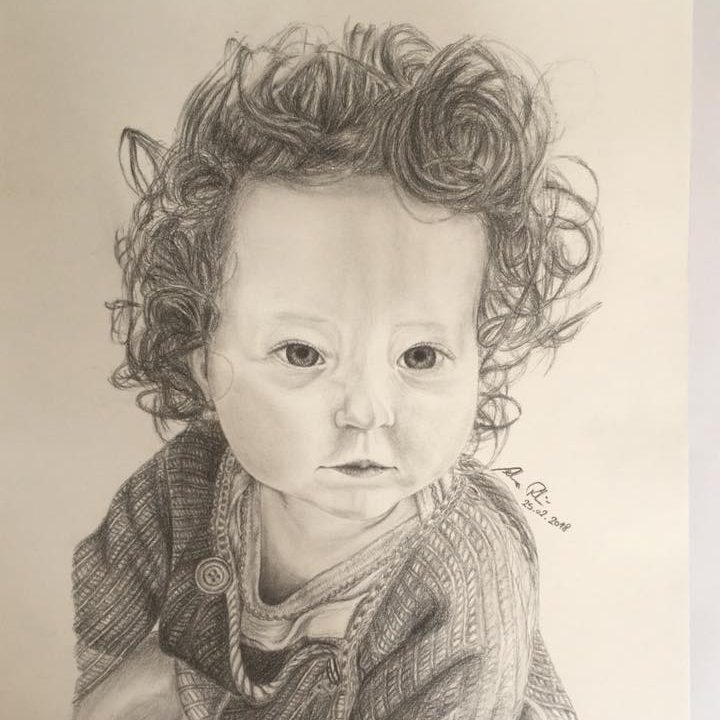
Eleanor KAT6A: When Dreams Learn to Fly
There are moments in life when you have to find yourself and you also find others. Being a teacher helps to make young people find themselves and others. With our project “Eleanor KAT6A: When Dreams Learn to Fly” we have discovered talents, awakened empathy and found common ground that connects together: family, friends, acquaintances and school community. It shows wonderfully what it means to be strong together, for others and ultimately for yourself as well. We’re taking part in the Strong School Award and I can only say one thing and proudly: You have this project in so many different ways carried along and helped, that dreams fly and become reality.
THANK YOU!
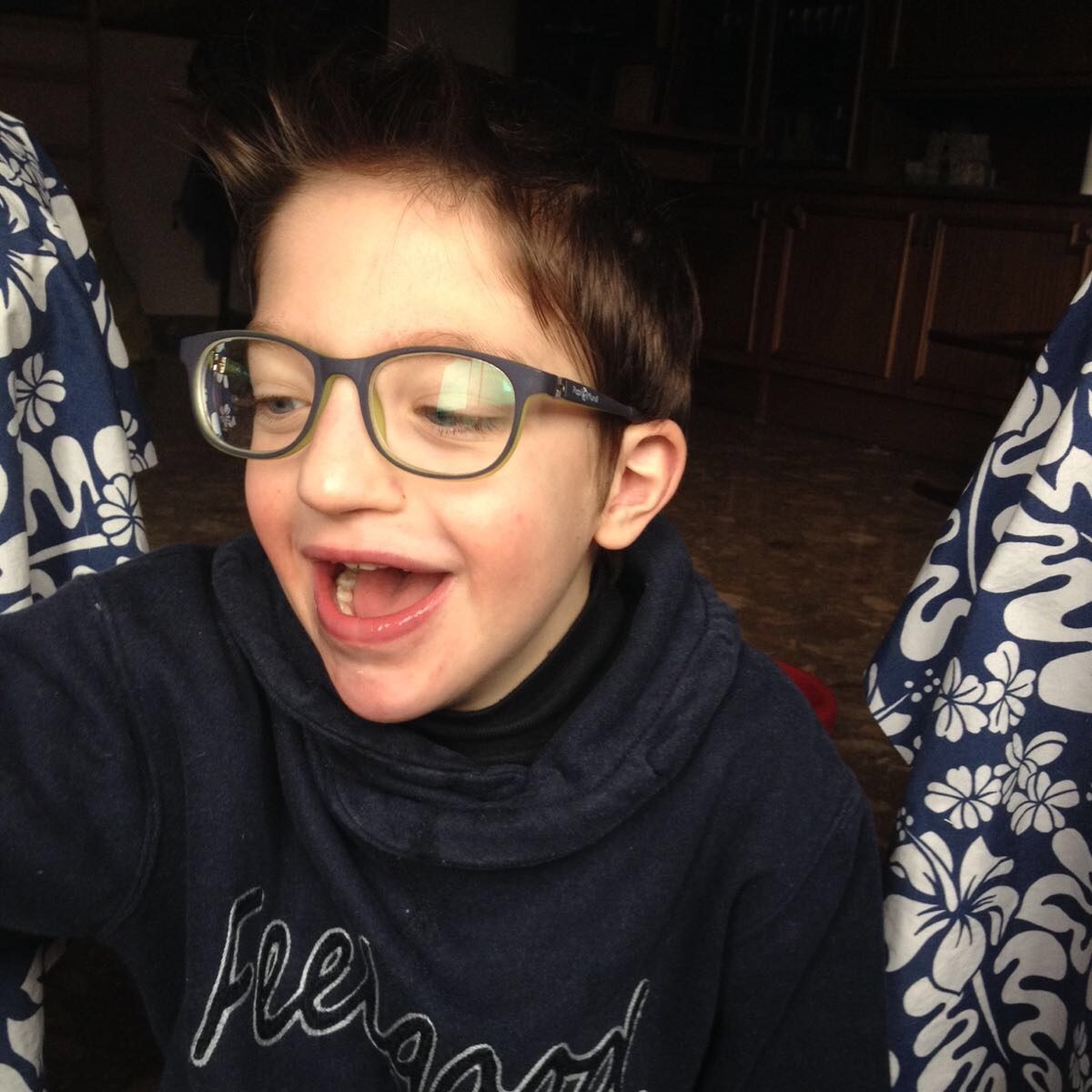
Beloved Pol from Spain
Pol nació por cesárea en diciembre de 2008 en Tremp, un pueblo del prepirineo catalán de la provincia de Lleida (España). Solamente nacer los médicos se dieron cuenta de que alguna cosa no iba bien, tenía alguna malformación y no tenía el instinto de succión que tienen los bebes al nacer, y a consecuencia no comía debidamente.
A las 24 horas de nacer se lo llevaron a la UCI del hospital Arnau de Vilanova de Lleida. Allí estuvo 6 días mientras se le hacía todo tipo de pruebas, también genéticas. Pol tiene unos rasgos característicos que son los que pusieron en alerta a los médicos; los ojitos separados, sus orejitas son distintas una de la otra, la lengua es grande,…
En el hospital descartaron algunos síndromes sin encontrar nada, así que nos fuimos a casa pensando que el problema era todo físico.
Pasaban los días y veíamos que el Pol no se comportaba igual que los niños de su mismo tiempo, y en sus revisiones pediátricas nos dimos cuenta que su cabeza era pequeña y le crecía muy despacio. En un principio se creyó que su cráneo se cerraba demasiado rápido y no dejaba que su cerebro creciera con normalidad, pero no era así, sino que era el cerebro que no crecía y por eso el cráneo se cerraba tan rápido.
A partir de entonces empezamos las visitas a neurología, sin pensar que el problema de Pol iba más allá.-“este niño necesitará mucha estimulación para tirar adelante”- nos decían, y nosotros pues…a estimularlo a tope…
Pero un buen día, un médico nos dijo –“¿vosotros sois conscientes que vuestro hijo será siempre un niño especial?”- supongo que lo sabíamos pero no lo quisimos creer hasta aquel momento.
…síndrome polimalformativo, retraso psicomotor, microcefalia, protusión lingual, disfagia esporádica, hipotonía general, y un largo etc…fueron las palabras que empezamos a oír a partir de entonces.
…eco cerebral, ecocardio, RM craneal, RNM cerebral, tránsitos digestivos, potenciales evocados, cariotipo, estudio de cromosomas, estudio metabólico, y otro largo etc…pero sin ningún diagnóstico.
Los primeros años de Pol fueron muy duros; primero por tener que aceptar lo que estaba pasando y procurar, como madre, no sentirte culpable pensando si había hecho alguna cosa que hubiera perjudicado a Pol mientras estaba en mi barriga; y después por las muchas visitas a hospitales, médicos públicos y privados, pruebas, terapias,… y sobre todo por las operaciones…
A los 3 meses lo operaron de hernias inguinales, todo fue bien.
A los 2 años, fimosis e hipospadia, todo salió bien, también.
A los 4 años, hernia hiatal; Pol siempre tuvo problemas de reflujo gastroesofágico y esto le provocaba acidez y a su vez vómitos que les llaman “poso de café” debido a su color. Resulta ser sangre digerida que tiene en el estómago por culpa de unas pequeñas llagas, y cuando sale esta sangre en el vómito lo hace en el color del café.
Después de algunas pruebas y unos días de ingreso se nos dijo que cuando Pol pesara 10kg; algo que costó un tiempo porque a Pol siempre le ha costado mucho ganar peso; le operarían.
La operación fue bien, le hicieron un NISSEN, que resulta ser una especie de “nudo de corbata” que hacen en la boca del estómago. Nos advirtieron que si este “nudo” no conseguían hacerlo bien preciso cerrarían el estómago más de la cuenta y Pol no podría volver a comer normalmente, y le pondrían un botón gástrico; así que cruzamos los dedos para que todo saliera bien y así fue. Ahora Pol come normal, pero le ha quedado una secuela, no puede vomitar y en algunos momentos les es desagradable, por suerte ya lo tenemos controlado.
A los 6 años, operación de corazón; “tabique interauricular con defecto amplio de 11mm”, es decir que tenía dos cavidades del corazón conectadas y el corazón le crecía más de un lado que del otro y se le tuvo que poner un parche para cerrar el agujero que las unia. Primero lo probaron por cateterismo pero no pudo ser, el agujero era demasiado grande y el parche no aguantaba; así que se lo acabaron haciendo con cirugía. La operación salió bien, pero la recuperación fue muy dura para él.
Otras cosas destacables de la evolución de Pol:
. Comió triturado hasta pasados los 3 años.
. Lengua con poca movilidad y siempre fuera de la boca.
. Babeo abundante.
.No fijó la vista y manipulaba los objetos con las dos manos por separado hasta los 4 años.
. Trastornos del sueño, que aún hoy estamos tratando.
. Problemas de caries en los dientes y está a la espera para sacarle los 4 dientes de leche delanteros de la parte de arriba para que puedan salir los definitivos.
. Le costó mucho voltear (hacer la croqueta)
. Sedestación a los 24 meses aproximadamente.
No gateó nunca y empezó a andar con soporte a los 5 años y a los 6 años empezó a andar solo. Ha hecho y hace diferentes terapias, en su caso todo suma, cualquier estimulo es bueno y ayuda a su evolución.
Pol estuvo utilizando bipedestador durante un largo tiempo, tenía peligro de luxación de cadera debido a no ponerse de pie, los huesos de su cadera no encajaban debidamente. Lleva férulas para andar porque la posición de los pies no es del todo correcta y también le dan más estabilidad.
Va a una escuela “norma” inclusiva. Siempre hemos pensado que mucha parte de su buena evolución ha sido por compartir muchos momentos con los compañeros de su escuela, y siempre ha tenido el soporte que ha necesitado.
Le gustan mucho los sonidos y las texturas, poner cosas dentro de un recipiente y moverlo es su juego preferido, o jugar con una montaña de hojas secas.
Seguro que hay un montón de cosas que explicar de Pol, pero para nosotros, sus padres, lo más importante de todo es que él es un niño muy querido por todos lo que lo conocen, es muy cariñoso y muy feliz, y lo mejor es que esto lo ha conseguido sin tener que hacer ninguna terapia ni tratamiento.
Muchas gracias por dedicar este ratito a leer la historia de nuestro hijo.
-Marco
English Translation:
POL MONSÓ PARRAMON
Pol was born by caesarean section in December 2008 in Tremp, a town in the Catalan pre-Pyrenees in the province of Lleida (Spain). Just being born, the doctors realized that something was not going well. He had some malformation and did not have the instinct of suction that babies have at birth, and a consequently did not eat properly. He was taken to the ICU of a hospital in Lleida 24 hours after birth. There he spent 6 days while he was done all kind of medical tests, also genetic tests.
Pol had some characteristics features that draw attention to doctors; his eyes were too separated, his ears where different from each other, his tongue was bigger than normal…
In the hospital the doctors discarded some syndromes but didn’t find out anything about what was going wrong with Pol.
So we went back home thinking that his problem was a physical issue.
The days went by and we noticed that Pol did not behave like children of his age, and in his paediatric check-up we realized that his head was smaller and was growing very slowly.
At first, it was believed that his skull was closing too fast and did not allow his brain to grow normally. But, actually it was the brain what did not grow enough and that’s why the skull closed so fast.
From then on, we began visit to neurologist, without thinking that Pol’s problem went further –“this child will need a lot of stimulation to move forward”- they told us, and we….to stimulate him in to the fullest…
But one day, a doctor told us –“Are you aware that your child will always be a special child?”- I guess we knew it but we did not want to believe it until then.
…polimalformative syndrome, psychomotor retardation, microcephaly, lingual protrusion, sporadic dysphagia, general hypotonia, and a long etc….were the words we began to hear thereafter.
…cerebral echo, echocardiography, cranial MRI, digestive transits, evoked potentials, karyotype, chromosome study, metabolic study, and other long etc… but without any diagnosis.
Pol’s first years were very hard. First, we have to accept what was happening and try, as a mother, not to feel guilty thinking if I had done something that would have hurt Pol while. He was in my belly; and then for the therapies… and above all for the surgery.
When he has 3 months he underwent inguinal hernias, and everything was fine.
At his 2 years old, phimosis and hypospadias, everything went well, too.
At his 4 years old, hiatal hernia; Pol always had problems of gastroesophageal reflux and this caused him acidity and in turn vomiting that they call “coffee grounds” due to its colour. Its turns out to be digested blood that has in the stomach because of some small sores, and when it comes out this blood in the vomit does it the colour of coffee.
After some medical test and a few days in hospital we were told that when Pol weighed 10kg, they would operate him. That was something that took time because Pol always had a hard time gaining weight; they would operate him.
The operation went well, they did a NISSEN surgery which is kind of “tie knot” that they make in the pit of the stomach. They warned us about if this “knot” wasn’t done quite well he stomach would be more closed than necessary and Pol would not be able to eat normally never again, and they would have to put a gastric button on it. So we crossed our fingers so everything went well and that’s the way it went. Now Pol eats normal, but he has a sequel left, he cannot vomit and sometime it is unpleasant for him. Luckily, we have it under control.
Al 6 years old, a heart operation; “interatrial septum with 11mm wide defect”, that is, it had two heart cavities connected and the heart grew more on one side than on the other, so a patch had to be placed to close the hole that united the cavities. First, they tried it by catheterization but the hole was too big and the patch could not stand; so they ended up doing it by surgerying. The operation went well, but the recovery was very hard for him.
Other remarkable things about Pol’s evolution:
. He had ate crushed food for over 3 years old.
. Little mobility of the tongue and always outside the mouth.
. Lot of drooling.
. He didn’t focus his sight not manipulate objects with both hands separately until he was 4 years old.
. Sleep disorder, which we are still dealing with today.
. Cavity problems in his teeth and he is waiting to his 4 frontal superior milk teeth be removed in order to let the definitive teeth go out.
. Rolling over himself was very difficult for him.
. He was able to keep sitted when he was 24 month old.
. He never crawled. He began to walk with support at 5 years old. One year later he was able to walk alone.
. He has done different therapies, in his case everything add up, any stimulus are good and help his evolution.
Pol had being using the standing frame for a long time. He had a risk of hip dislocation due to not standing up, the bones of his hip did not fit properly. Wears splints to walk because the positions of the feet is not entirely correct and also gives more stability.
He goes to an inclusive “normal” school. We have always thought that a lot of his good evolution was thanks to share many moments with his schoolmates, and he always has the support he needed from them.
He likes sounds and textures a lot, putting things in a container and shake it is his favourite game, or playing with mountain of dry leaves.
Sure there are a lot of things that we can explain about Pol, but for us, his parents, the most important thing above all is that he is a very beloved child for all that know him. He is very affectionate and very happy, and the best thing is that this is not consequence of any therapy or treatment.
Thanks you for taking your time to read our son’s story.
Este domingo hemos hecho un paso más en dar a conocer KAT6A, corriendo la ZURICH MARATÓN BARCELONA junto con unos grandes amigos, los TREMP RUNNERS y Pol, el protagonista, aquí teneis un resumen en imágenes. Nos hemos divertido muchísimo.On March 11,2018 we have made one more step in making known KAT6A, running the Zurich Marathon Barcelona along with some great friends, the Tremp Runners and Pol, the protagonist, here you have a summary in images. We had a lot of fun.Watch Video!
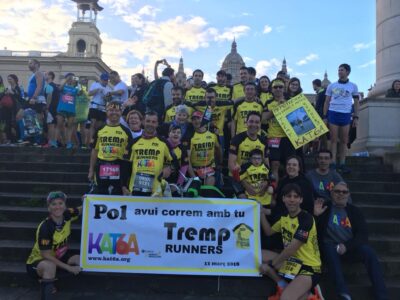
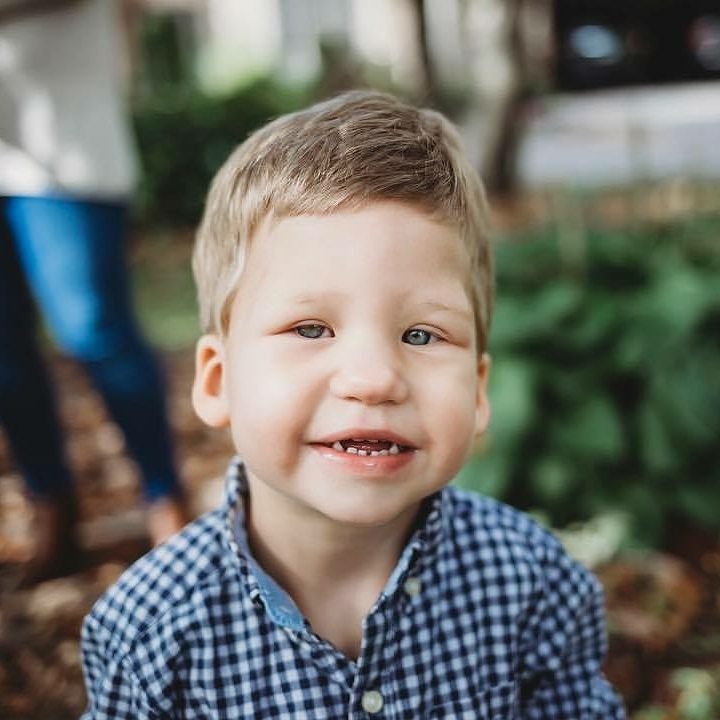
Meet Chase
Chase is 3 years old and one of the happiest kids I know. He is the third youngest out of four kids and couldn’t love his siblings more. He is happy just to sit by his big brothers and watch them play video games. :)
Chase’s story started November 1, 2014 when he was born via emergency c-section. Nothing about the delivery was ideal. We started out going in to get induced and having Chase manually flipped around in my belly. Once his heart rate fell the doctors decided it would be best to get him out as quickly as possible. When Chase was born he was immediately intubated due to meconium aspiration. Little did we know this was the best thing that could have happened for him.
Chase was brought straight to the NICU. Everyone assured us that it was just for observation and he would be joining us shortly. After hours turned into days of him not coming to our room I knew something was wrong. When Chase was 3 days old he had an X-ray of his lungs to check on the meconium. Luckily his heart was also in this X-ray because that is how they found his heart defect. Chase had 3 holes in his heart along with a valve problem. If it weren’t for him aspirating on meconium we would never have figured this out so soon.
Once the heart defect was discovered the whirlwind started. They started looking into what could have caused this and they decided it was probably genetic. That’s when the testing started, the specialists started coming around, and problem after problem was being found.
Chase had a g-tube placed and a nissen fundoplication when he was 5 weeks old. It was decided that eating orally just wasn’t going to happen for Chase at that time. Exactly 2 weeks later, at 7 weeks old, Chase under went open heart surgery to repair his heart.
At 10 weeks old Chase got to leave the hospital for the first time. We learned what our new normal was with a medically complex child but we still didn’t have an answer to why this all was happening to him. When Chase was one year old we finally got the results form the whole exome sequencing and that is when we got our answer, KAT6A.
Since being diagnosed with KAT6A, we have learned a lot and met so many great people. The KAT6A support group has been a life saver. When your child’s doctor tells you they have never seen a child with your child’s diagnosis and is unable to answer all of the questions you have from this life changing test result you feel completely lost. The other parents of kids with KAT6A have been there to answer questions, give words of encouragement, and just be there when you need it.
This isn’t the life I asked for but it’s the one that was meant for me.
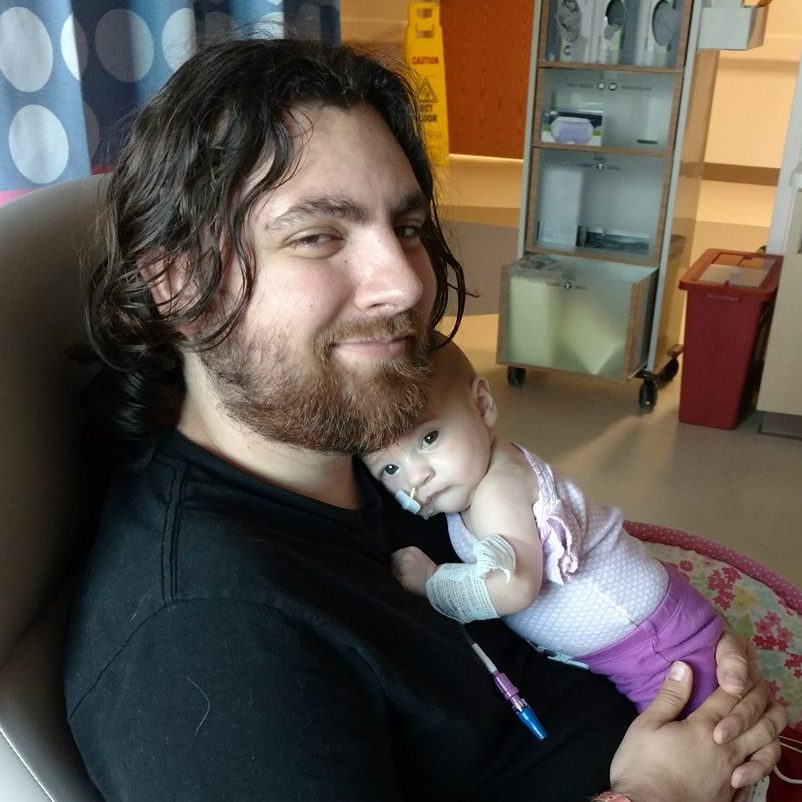
Both Sides of the Bed
It’s a scene I’m very familiar with. The parents sit across from me, anxious and fidgety. Sometimes they cry, sometimes nervous giggles. Always fear. Confusion and concern for their child. As a psychiatric nurse, I know the parents are, by extension, secondary patients that I must also care for. I help calm them down as they try to rationalize their child’s attempt, or most recent self-harm. I reassure them that this isn’t the end of the world. There is hope for them and for their child. I help them come to grips with their loss of control. I explain the treatment, sometimes I can explain the behavior. Sometimes it is more normal than they realize. Patient care is something I’m fairly familiar with; it is easy to comfort from the outside looking in.
But then, it’s your own child…and everything is different.
You realize your hypocrisy. All those times you reassure and quiet their fears, only to spiral in panic as soon as you are placed in their shoes. There is a realization that hits in, how little control you have, and how truly helpless you are. You are simply a silent observer, through tear-stained glasses, forced to watch a tragic performance, deviating from a script you didn’t write.
Every lab draw was agony. Every IV and test broke me. Even the feeding tubes and consistent weight loss. Almost every procedure was something I had done before or observed. I never imagined during my training that I would see my own daughter submitted to the same. All of my experience and training was useless. Everything is different when the patient is your child.
I remember holding my precious girl’s little hands, listening to the doctor explain, again, how they didn’t know what to do. I prayed silently, hoping someone could hear me. So much uncertainty. Every test and every potential answer was a red herring. I didn’t know how much longer I would be able to refer to my daughter in the present tense. That question burned in my head every time I visited the NICU.
I finally interrupted the doctor to ask as bluntly as I dared. “Will my baby die?” The doctor replied through tears that she did not know. I left feeling nothing. I had no more tears to give and no strength to feel sorrow. I had to accept that my daughter would probably never come home.
That type of pain damages you. In some ways, you do not fully recover. It is almost as if part of your soul dies in that moment. I cannot begin to imagine the pain of actually losing your child. My daughter pulled through…but there is still a large scar in my heart. It will haunt me, forever.
It was so difficult to accept that my daughter would live. Almost more difficult than accepting that she wouldn’t. Answers came, and with them, solutions…but none of it felt real. It took a while for me to hope again. To let myself plan a future. To assume she would be OK.
I did, though. My daughter, diagnosed with KAT6A, is developmentally delayed…but healthy, living, and progressing. We are a part of a support group, and going to a clinic specifically for KAT6A in a couple weeks. Her story isn’t over.
At this point, I would love to end with a cheesy message of hope. But I have none. Only a message of pain. But pain can connect people, and strengthen bonds. Pain bares open our souls and reveals our truest self.
If you are reading this, you have likely experienced pain. Perhaps you, like me, have had to watch your loved one suffer. Just know that I, too, feel your pain. I do not understand it. Yours is unique to you, and I will never claim to know how you feel, but know you do not suffer alone. We all carry our own burdens, often too heavy to hold on our own. I share my pain with you. If it somehow resonates with you, please consider sharing your own pain. Allow us to share your suffering. You do not need to hurt alone.
Medical News
KAT6 Clinic Opens at Boston Children's Hospital
Major Development: A KAT6 Clinic Has Opened at Boston Children’s Hospital
We’re excited to share that a new multidisciplinary clinical program for individuals with KAT6A and KAT6B is now open at Boston Children’s Hospital, led by Dr. Olaf Bodamer and Dr. William Brucker. This clinic will serve as a true medical home for families, offering coordinated care across specialties.
The KAT6 Foundation is proud to have helped fund the development of this program, made possible through the generosity of our donors.
As the team continues organizing the clinic, families who are interested in care are encouraged to contact rarediseases@childrens.harvard.edu. This inbox is monitored several times a day, and families can expect a response within 24 to 48 hours. After reaching out, families will receive an intake form and the opportunity for a brief informal meeting to discuss expectations. Appointments for an initial evaluation are available on a regular basis with Dr. Brucker and/or Dr. Bodamer.
In addition to patient care, the clinic will gather natural history data and collect biospecimens for the IRB-approved KAT6 biorepository, which supports ongoing biomarker discovery. The clinicians will also continue collaborating with research partners such as the Serrano Lab at Boston University.
For appointments or additional details, families can reach the clinic coordinator at rarediseases@childrens.harvard.edu
300 Longwood AvenueBoston, MA 02115
Bowel Obstructions in the KAT6 Population
Parents and caregivers of children or adults with KAT6 disorders are the first to recognize whether the person they care for is in distress. Those continually looking after the person’s needs are the best ones to intervene and advocate for medical care when it appears that a problem is present and getting worse. But what are we looking for and when might it call for emergency care?
INTESTINAL BLOCKAGE
Gastrointestinal issues are common with KAT6 disorders. Low muscle tone throughout the body may mean low motility in the gut — weak contraction of the muscles that mix and propel contents in the gastrointestinal tract. When there is a temporary lack of normal muscle contractions of the intestines this is known as ileus — not a blockage, but a stoppage. (Think of a blockage as a train wreck, preventing any other train from passing through, and think of a stoppage as merely a train sitting on the tracks and failing to move along.)
When the contents of the upper or lower bowel cease to move, the resulting mass can become enlarged and can harden as it dries out, stretching the part of the intestine where the mass occurs. Regular contractions can return and eventually move it along, but if the contents sit too long they can begin to ferment and decay, with potentially serious results. Vomiting and diarrhea, for example, are normal consequences once the body applies its other resources to the obstruction.
If it does not eventually start moving on its own it may respond to non-invasive treatments such as stimulants taken orally or a rectal enema, depending on proper assessment of the location of the problem. But if there is a physical barrier to continued movement of intestinal contents, the problem can quickly become life-threatening.
MALROTATION AND VOLVULUS
Around the tenth week of gestation, as the intestinal tract is developing, it normally moves from the base of the umbilical cord into the abdominal cavity. As the intestine descends into the abdomen, it makes two rotations and settles into its normal position. When a portion of the intestine, or even the entire intestinal tract, fails to lie properly in this space, it ls known as a malrotation.
A malrotation may cause immediate symptoms and problems after a baby is born or may lead only to intermittent trouble, or it may cause no problems at all. In some people it is not discovered until well into adulthood or perhaps never discovered at all. In others, it can be the source of repeated obstructions. The point is, a malrotation is an anatomical defect and one that must be suspected if problems arise, especially in early childhood. It can lead either to continuous or intermittent problems but is not necessarily dangerous.
When a loop of intestine and the membrane that holds it in place twist around each other like sausage links or a kinked garden hose, this causes a bowel obstruction called a volvulus. A certain kind of volvulus in a horse is commonly called a torsion. It is not going to clear and open back up on its own, and normal muscle contractions in the gut are not going to force a trapped mass of intestinal contents to move past it.
The trapped material, already partially digested, continues to break down, though, and some contents may be ejected as diarrhea or gas, while most of it will remain and swell the gut. A person suffering a volvulus, who enters emergency surgery soon enough, may still lose part of the intestinal tract in surgery. Without emergency surgery a volvulus is almost certain to be fatal.
If a volvulus is suspected in an emergency room, a buildup of gas in the intestine may show up on a series of x-rays, which must be taken at intervals long enough for changes to appear but no so long that surgery comes too late.
OTHER GI ISSUES
The esophageal sphincter is the valve between the esophagus and the stomach. When the muscle that keeps this valve closed is weak, a blast of burning stomach acid may rise as far as the throat. This is acid reflux. A baby with KAT6A or KAT6B can be resting quietly in a baby seat, alert and cheerful, and suddenly scream in pain and terror. If this happens with any frequency, reflux should be suspected when nothing else is likely.
Dumping syndrome is a group of symptoms, such as diarrhea, nausea, and feeling light-headed or tired after a meal, that are caused by rapid gastric emptying, a condition in which food moves too quickly from the stomach to the duodenum. This can become an issue after a person has undergone GI surgery. Adjustments in diet or medicine can resolve things, and, if surgery was involved, time may be the best healer.
OUR NEED TO REMAIN VIGILANT
Communication problems are common with the KAT6 population as well as an apparent high tolerance for pain. Children and adults with KAT6 disorders, especially those who can’t tell us that something hurts or where it hurts, need to be monitored continually for lack of gut movement. Constipation, (a general term for any disruption of intestinal activity that leads to pain and irregularity of bowel movements), can make a normally cheerful person irritable.
A volvulus is a rare occurrence in the general population, but among the KAT6 population it seems common enough to be of serious concern. Although we are still studying the matter and don’t have statistics, it appears that untreated bowel obstructions are the leading cause of death among children affected by KAT6 disorders.
Many of those with KAT6 disorders are tube-fed through a gastrostomy. For some, this is their only source of nutrition, and so variations in gastrointestinal activity are less likely to be caused by daily changes in diet.
What is the person’s normal frequency of bowel movements? Has it been a day longer than normal? Two days? Is she also becoming irritable, combative, unable to sleep? Does this happen in repeating cycles? What does her blood work show? What does a gastroenterologist say? Do cycles of irritability correlate with cycles of unusual toilet contents? Someone close to the patient needs to be asking these questions and insisting on answers.
People with KAT6 disorders may show no signs of a bowel obstruction until it has progressed to a serious degree. They may quietly tolerate the increasing pain until it has become severe. An obstruction can go from bad to dangerous quickly. It is hard to differentiate an obstruction from other gastro-intestinal issues. Obstructions can happen again and again and can strike at any age.
While it is probably more likely to become an issue early in a child’s life, an affected person who has a KAT6 disorder can seem to be OK for years, perhaps irritable at times for no apparent reason. Just because it hasn’t been diagnosed at an early age it could be that a complete obstruction simply hasn’t happened yet. The best prevention of complications is be on top of it all of the time. Not all doctors understand that, with a bowel blockage, you can still pass diarrhea — the assumption seems to be that if they’re passing anything at all then there’s no obstruction.
Medical services vary from country to country, and while another country may have excellent hospitals and perfectly competent doctors, they may also have different approaches to parent involvement, different protocols for intervention, and different standards for what can and should be treated.
Compounding the danger, a doctor may not consider an intestinal obstruction if a parent or caregiver hasn’t suggested it, and so a doctor wants to ascribe a change in behavior to anxiety, a virus, a food allergy, and so on. Meanwhile the child has mere hours to get the problem resolved or else irreversible damage has been done with a high potential for fatal results.
LIVING WITH IT
We aren’t supposed to tell people about our poop or ask others about theirs. With KAT6 in a family we could save a life if we get beyond that taboo. In our own experience, Beth and I share in all phases of the care of our son, Sam, who is now 32 years old. He is one of the more severely disabled individuals with KAT6A syndrome, and so we must pay constant attention to all the signs he gives us. We “read” his behavior, we both examine his bowel movements daily or at least describe to each other what he has done. (He even has an “I POOPED TODAY” T-shirt.)
Sam has had a gastrostomy and feeding tube since he was a baby and receives all medicine and sustenance through the tube. He had a nissen fundoplication during his first surgery as a baby, so he cannot burp or vomit. He had a malrotation of the duodenum at birth (corrected by surgery), reflux as a baby, a volvulus before he was two (indicated by changes in a gas pocket on successive x-rays), a second near-fatal obstruction due to adhesions, and numerous instances of ileus and other partial obstructions requiring hospital stays. As an adult he is now treated for ulcerative colitis. He does not walk and can’t speak. But he is engaging and even mischievous, affectionate, enthusiastic, and popular. When he hurts, his only ways to show it are in withdrawal, resistance, and restlessness.
We are fortunate that Sam has had doctors who care about him as a person and who listen to us, his parents. His doctors, though, need to trust what we are telling them, and so our information must be reliable. By educating ourselves, paying close attention to the signs that Sam gives us, and making sure we communicate consistently and accurately with medical providers, we have been Sam’s best advocates.
Many parents have observed GI benefits from a mitochondrial cocktail and other supplements, such as Cytra-3. Learn more about these supplements by watching Dr. Richard Kelley’s presentation from our 2022 Conference. It is essential to consult your child’s physician before starting anything new.
Foundation News
KAT6 Foundation: Leadership Update
Dear KAT6 Families, Friends, and Partners,
We are writing to share an important update about the KAT6 Foundation’s leadership.
The Board of Directors would like to share an important recent change to our organization. After eight years of incredible service to our community, Natacha Esber and Emile Najm, the founders of the KAT6 Foundation, have made the decision to step down from their positions as Chair of the Science Committee and CEO, respectively. We extend tremendous gratitude to them as the creators of our foundation, and as tireless advocates for our mission to advance scientific research and to support our families. There is no part of this organization that has not been touched by their incredible passion, vision and drive. Natacha has advanced scientific research and provided countless hours of medical advice to numerous families. Emile has run the legal and financial aspects of our foundation, as well as overseeing all of our committees. Together they created our conferences and enthusiastically welcomed new families into our fold.
We are beyond grateful to them for founding this organization and for the many years of dedication, vision, and relentless work they have poured into building a brighter future for individuals living with KAT6A and KAT6B. Their leadership helped create the strong foundation we stand on today, and because of their efforts, our community, our research network, and our global visibility have grown in extraordinary ways.
They will always be a cherished part of our community, and we hope you will join us in thanking them for their years of service and lasting impact.
Our Board of Directors is fully engaged and will be stepping in collectively to ensure uninterrupted operations during this transition. In the meantime, Jordan Muller will be serving as Interim Executive Director, providing operational leadership, coordination, and continuity.
Our Science Committee members will continue their work without interruption, and all funded research projects and partnerships remain active. There will be no delays or changes to ongoing scientific or community initiatives.
The heart of the KAT6 Foundation has always been our community and the many dedicated parents, caregivers, clinicians, and volunteers who bring this work to life. That remains absolutely unchanged.
As the Foundation evolves, we will post several new roles in the coming weeks. If you or someone you know would like to join our mission, we would love to hear from you. Our team is mostly made up of parents and caregivers, but not entirely, and we welcome anyone with a passion for helping this community thrive. Please keep an eye out for position announcements soon.
We are also thrilled to share that planning is underway for our first ever KAT6 Family Weekend in 2026. This is a milestone event many of our families have dreamed of. We cannot wait to bring our community together in person for connection, learning, joy, and support. The date and location will be announced in January 2026, and we look forward to seeing you all there.
We are confident that this next chapter will bring continued growth, clarity, and opportunity for our community. Our mission remains unwavering: to advance research, strengthen family support, and build a connected global community for every individual living with KAT6A and KAT6B.
With deep gratitude for Emile and Natacha’s incredible service, and with excitement for the road ahead, we thank you for your trust, your compassion, and your partnership.
With appreciation,
The Board of Directors
KAT6 Foundation
For more information: Q and A
The Story Behind 'KAT6 and Me': Turning a Family's Journey into Hope
When Kristin Ross O’Brien’s son Max wanted to write a school report about his younger brother’s rare genetic condition, she made a surprising discovery; there were no children’s books about KAT6.That moment sparked a dream: to create the story that didn’t yet exist.Together with her friend and child life specialist, Dr. Lindsey Murphy, Kristin brought that dream to life in KAT6 and Me; a beautifully written and illustrated book that teaches, comforts, and celebrates children living with KAT6 disorders, while helping others understand and include them.“The idea for KAT6 and Me began with Max,” Kristin recalls. “He wanted to write about KAT6, but there weren’t any books, not even for adults. From that moment, it became our family’s wish to one day write the children’s book that didn’t exist; a story that could teach, comfort, and celebrate kids like Bash, and help others understand them too.”
A Collaboration Built on Friendship and Shared Purpose
Kristin shared her idea with longtime friend Dr. Lindsey Murphy, an associate professor of child life at Missouri State University. The connection between the two was immediate.“I’ve been a witness to Bash’s journey from the beginning,” Lindsey says. “Knowing there was something tangible I could do to support their efforts for education, inclusion, and advocacy was an easy ‘yes.’”The writing process flowed naturally.“We’d already been friends for years, connected through a playgroup for our kids,” Lindsey explains. “Kristin brought the heart and soul. She knows her child and the KAT6 community better than anyone. My background as a child life specialist helped us make complex or emotional topics understandable for children. Together, we blended those strengths.”Kristin agrees that the process was both heartfelt and fulfilling.“We wrote this book in the fringes of our lives- over coffee while our kids happily destroyed the playroom,” she laughs. “We talked about how to highlight Bash’s abilities instead of just his challenges, and how to weave facts into storytelling that still felt magical.”
The Heart of the Story: Bash
At the center of KAT6 and Me is Bash, Kristin’s youngest son, whose journey has inspired many.“Bash came into our lives first as our foster son when he was six months old and instantly captured our hearts,” Kristin shares. “Before he turned two, we were blessed to officially adopt him and make him a forever part of our family.”Diagnosed with KAT6B syndrome as an infant, Bash’s life has been filled with both challenges and incredible joy. Despite facing multiple therapies, surgeries, and medical complexities, his optimism and determination shine through.“Every small victory, every sound, and every step for Bash is a celebration,” Kristin says. “He’s a kindergartener, a disability advocate, and even a playground philanthropist. . . helping bring adaptive playground equipment to our small town. His happy personality touches everyone he meets.”
A Bridge for Families, Educators, and Professionals
Both authors hope KAT6 and Me will serve as more than a story. They see it as a bridge for connection and understanding.“For families, I hope this book gives language they can use to explain a diagnosis in a positive, age-appropriate way,” Lindsey says. “For professionals, I hope it reminds them that small gestures, listening, explaining clearly, offering hope — make a lasting impact.”Kristin adds,“My greatest hope is that KAT6 and Me becomes a bridge. I want families who are newly diagnosed to feel less alone. I want siblings to have words that help them explain and celebrate their brothers and sisters. I want teachers and classmates to see what inclusion looks like- to recognize that kids with complex needs have the same love of laughter, friendship, and play as any other child.”
A Ripple of Awareness
Since its release, KAT6 and Me has reached far beyond the rare disease community.“We expected families affected by KAT6 to be our main audience,” Lindsey notes, “but teachers, advocates, and libraries across the world have embraced it as a tool for inclusion and awareness.”Kristin and her family have shared the book through local events and readings in Boonville, Missouri, and have donated copies to schools, hospitals, and libraries.“Parents of children with rare diagnoses have sent us pictures of their kids holding the book,” Kristin says. “Teachers have told us they’re using it to start conversations in classrooms. And siblings, kids like my Jack, Max, and Leah, now have a way to explain and understand their brother’s condition. That’s exactly what we dreamed this book could do.”
Giving Back to the Community
To honor the children and families affected by KAT6 disorders, all royalties from KAT6 and Me are donated to the KAT6 Foundation to support research, awareness, and family connection.“Every purchase helps fund the search for answers and celebrates children like ours,” Kristin explains.Lindsey and Kristin’s collaboration continues, with plans for additional projects to serve families across the KAT6 community.“Our conversations keep sparking new ideas,” Lindsey says. “We already have plans for more books to reach other audiences within the KAT6 community.”
A Story That Connects and Inspires
What began as a school project has grown into a heartfelt movement of awareness and inclusion. Through KAT6 and Me, Lindsey Murphy and Kristin O’Brien remind readers that every story, no matter how small, has the power to connect, to teach, and to bring hope to families everywhere.“I learned that hope grows when it’s shared,” Kristin reflects. “Every message from another family, every photo of a child holding the book, reminds me that stories can connect people who might have otherwise felt alone.”About the AuthorsKristin Ross O’Brien is a writer, advocate, and mother of four living in Boonville, Missouri. Her family is passionate about inclusion and rare disease awareness.Dr. Lindsey Murphy is an Associate Professor of Child Life at Missouri State University and a dedicated advocate for children with complex medical needs.Read More about their journey in Q&A: Dr. Lindsey Murphy and Kristin Ross O'Brien
Empowering Families Through the Empowered Grant
"Wilder has done so well with the therapies she has received with the help of the Empowered Grant!" KAT6A and KAT6B syndromes are a pair of rare genetic variants that can cause a spectrum of health complications, impacting those diagnosed to varying degrees. As a foundation, we strive to spread awareness and advance research surrounding these syndromes. Part of this mission is fostering a strong community that supports individuals diagnosed and their families.
However, while essential and irreplaceable, support alone is not enough to address the wide range of complications many individuals face. Therapies and accessibility equipment—among other forms of treatment—allow individuals diagnosed with KAT6A and KAT6B to experience life more fully and with greater ease. Unfortunately, the more impactful the solution, the higher the cost—expenses that not everyone can afford.
Empowered Grants provide individuals diagnosed with KAT6A and KAT6B the funding needed to purchase assistive equipment, treatments, and technologies that may otherwise be out of reach.
Take Jack’s family, for example. While society has become increasingly accessible, there is still much work to be done—especially in historic areas where equipment like Jack’s wheelchair can be difficult to maneuver.
With help from the Empowered Grant, Jack’s family was able to purchase a portable ramp that has allowed them to take Jack into shops and restaurants with ease. Jack’s mother, Elyse, explains, “Purchasing and using the ramp in public has not only helped us, but helped many others, as the ramp has encouraged local business owners to purchase their own portable ramps for public use!”
Families have also used the grant to address more specialized needs. For example, David Exl explains that his daughter, Ella, was diagnosed with KAT6A, “which affects both her mental and physical development,” and “CVI (Cortical Visual Impairment), a visual processing disorder that makes it difficult for Ella to interpret visual stimuli.”
Using the Empowered Grant to fund Ella’s physical therapy, Exl shared that “a major milestone came in the fall of 2023 when she started crawling—it was the first time she could move around on her own.”
In addition to medical treatments, meaningful social connections have proven instrumental in the lives of KAT6 families. The Empowered Grant also supports these connections by helping families—like Siahna Anderson’s—fund special programs such as summer camps.
According to Shannon Anderson, Siahna’s mother, at “Adams Camp—a camp designed specifically for kids with special needs—” Siahna “gets to experience camp activities such as swimming, canoeing, horseback riding, summer tubing, shopping, and overnights with friends.” She also receives therapies such as speech, music, occupational therapy, physical therapy, and art therapy.
These programs offer individuals with KAT6 a sense of belonging and normalcy that may be difficult to experience otherwise. Living with any condition can be scary and isolating, but the opportunities made possible by the Empowered Grant can ease that burden through new experiences and meaningful connections.
Backed by our generous donors, we have awarded more than 120 Empowered Grants to KAT6 families around the world. Whether for medical equipment or specialized therapies, this funding provides individuals access to essential resources tailored to their unique needs. The KAT6 Foundation remains deeply committed to supporting our community through Empowered Grants—and the life-changing opportunities they make possible.
Learn more about how to apply for an Empowered Grant to support your child here.

KAT6 Foundation Selected as a 2024 #RAREis Global Advocate Grant Recipient
We're excited to announce that we've been selected as a 2024 #RAREis Global Advocate Grant recipient by the #RAREis program from Amgen! In total Amgen awarded 75 one-time $5,000 grants to global rare disease advocacy organizations to support programs and disease education initiatives.
We’re motivated to continue making a positive impact for the rare disease community by expanding our efforts in KAT6 education and advocacy as we work to address the needs of all those impacted.
Learn more about the #RAREisGrant here: https://www.rareiscommunity.com/rareis-global-advocate-grant/
#RAREisTM began as a social media campaign launched by Horizon Therapeutics, now Amgen, in 2017 to elevate the voices, faces and experiences of the rare disease community. It has since grown into a global program that provides individuals and families around the world with access to resources that connect, inform and educate as they navigate their daily lives. The hashtag (#), #RAREis, remains as a way to follow the conversation on social media and remains in the name and logo to represent the broader program and community. As part of their mission, they strive to improve the experience of living with a rare disease by providing support to many organizations that offer crucial programs and services for people living with rare diseases.
KAT6 on Screen
July 1, 2023
Working through ZebraKinder — our KAT6 counterpart in Austria, filmmaker Niko Mylonas has released the new production, “Genetic Defekt.” Coordinated by executive producer (USA) Emile Najm for the KAT6 Foundation and retaining its German title, the production is available in English narrated by our own Katie Bator as well as in its original German.
While the film does touch on the technical aspects of KAT6, it is, in essence, an opportunity to get acquainted with families at home and abroad who live with KAT6A and KAT6B. We of course want to educate ourselves on the ways in which the genetic defect expresses itself in its several variations, but the film centers around the daily lives of those affected.
We see in the film the spectrum from subtle, almost unnoticeable effect to severe impairment, depending on the type of gene anomaly — truncation, missense, deletion, and other variants. We meet Ella in Innsbruck and her advocate-aunt, Monika Rammal. We visit Gianna in Michigan, Samantha in Germany, Will in New York, Warren, Bay, Max, Hadley, and many more. We hear from some of the scientists and parent-advocates we’re familiar with including Dr. Jacqueline Harris, Dr. Angie Serrano, Aimee and Jeff Reitzen, Susan and George Hartung. We visit with the Najm family, who, on behalf of Peter, had the inspiration in 2017 to organize parents in starting a foundation for KAT6 support and research.
In addition to a glimpse into the everyday trials and sweet triumphs of those who live with KAT6, the film lets us spend a poignant few minutes with the parents of Helin, a girl in Germany who fell ill and, although brought to a hospital, did not survive. Her parents share the message to be learned from that tragedy.
While the film points out that the disease is yet rare, it is not new. Nor perhaps is it as rare as was previously thought. And that could be the film’s lasting contribution. Once you’ve seen it, show it to others, speak of it, send it, share it widely. Make it the centerpiece of a gathering or fund-raiser. And make clear that, whenever there is a question of a genetic irregularity in a child, testing is available. Our children deserve the care we can give, and we, as parents and caregivers, deserve the best information.
At 48 minutes in length, “Genetic Defekt” is a tool we have long needed to promote awareness of the adversity that has brought us together.
-OR-

Picture: Kuno Büsel (left) and Niko Mylonas (right)
We are pleased to announce that on September 28, 2023, the KAT6 Foundation was awarded the Austrian Child Welfare Award, the MYKI-Award 2023 for the film.
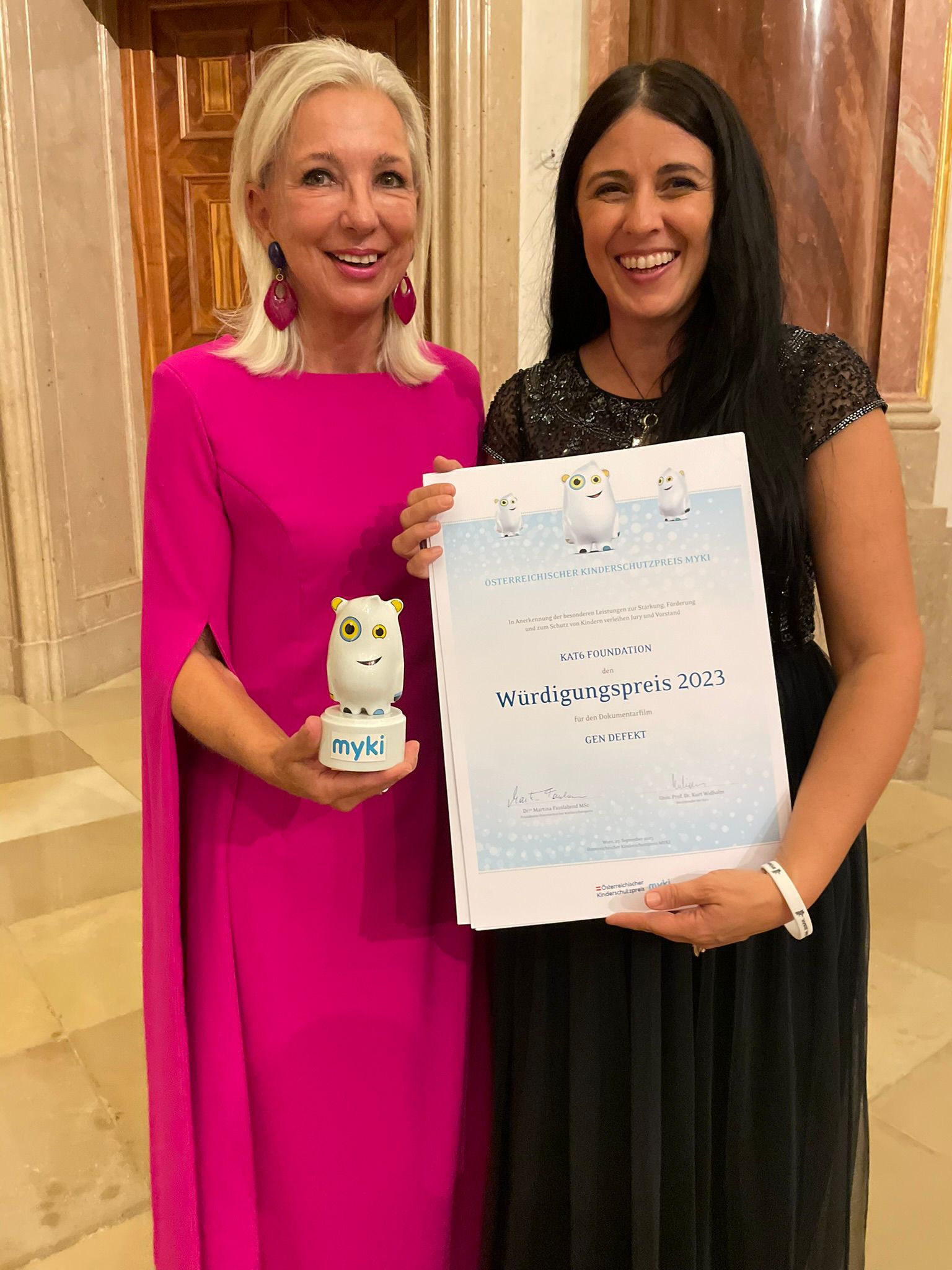
Picture: Executive Producer (Austria) Monika Rammal receiving the MYKI-Award on behalf of the KAT6 Foundation.
The KAT6 Foundation Establishes Committee to Study Mortality
TO ALL KAT6 CAREGIVERS:
A PLEA FOR INFORMATION
The KAT6 Foundation has established a committee to study mortality within our community. It is sobering to realize that there is a need for this. While we are all here to surround and support those burdened with the loss of a loved one, the ultimate objectives for this committee are to guide parents in understanding how best to adjust to KAT6 disorders and to prevent suffering among our most vulnerable members.
As parents we are silently alert for signs that our child is in distress, which can arise due to sickness, physical trauma, or emotion. We watch for the expected discomfort of common illnesses.
A child who is upset may simply be complaining out of selfishness or a violated sense of fairness, and what’s wrong can be easily fixed. When we hear crying or whining, though, especially when children are immature and lack verbal skills, we pay attention to the other ways they communicate.
AN OVER-RIDING CONCERN
Our children with KAT6 disorders must endure the usual childhood ailments, but they (and we) may not suspect less-common possibilities that lurk in the background. Heart conditions and bone frailty are two that have proved common, but one more affliction has been responsible for claiming the most lives among our affected population: bowel obstructions. Over a three-year period we have lost as many as five members of our tiny group to this tragic cause.
Slow motility in the gut — weakness of the muscles that push the contents along — is a common KAT6 disorder. Symptoms of a bowel obstruction are subtle at first and can be mistaken for something else. Obstructions do not readily clear without intervention, and there is no easy test until the situation has become critical.
Many of our kids have a high tolerance for pain and, when in distress, may at first seem merely to be cranky or anti-social. If their sleep patterns are already poor — and that is common — then we may not notice this one more thing contributing to their insomnia.
It is hard to imagine a child’s misery, unable to describe the pain, when we, the care givers who know our children, and the medical providers have not yet even suspected gut pain. And it horrifies us to think that a child can die not understanding why we are failing to do something to ease the agony.
WHAT YOU CAN DO NOW
With the high proportion of deaths due to this one cause, the mortality committee urgently asks parents and caregivers to help. With an eye to preventing the suffering of even one more bewildered and innocent member, the committee needs data, clear, reliable, factual information.
While we await autopsy reports, it is especially important that all KAT6 individuals be entered into the NORD Registry. The more we know about the ways in which KAT6 disorders are manifested the better the Foundation can support meaningful research, support caregivers, and help assure the comfort and well-being of the ones who have brought us all together.
To create a registry entry for a person with KAT6A or KAT6B, please use the link: https://kat6a.iamrare.org/Account/Register
To update an existing registry entry, and ideally you would do so annually, please go to: https://kat6a.iamrare.org/Account/Login
WHAT HAPPENS TO THE DATA
De-identified data in the KAT6A/KAT6B Patient Registry is available to scientists — including medical professionals, geneticists, pharmacologists, nutritionists, and others — who want to study any aspect of KAT6A and KAT6B. The KAT6 Foundation provides funding for many such research projects.
Members of the Foundation and the mortality committee are notified of the loss of a community member only through our support network, not by NORD or any other agent that is properly committed to privacy. Our ability, as a committee of the Foundation, to obtain an autopsy report and other information depends on the willingness of those who are affected and have access to the report and the details of the family’s loss.
To contact a member of the mortality committee, please use the contact form at https://kat6.org/contact or add a post to the KAT6 Support Group page at Facebook: https://www.facebook.com/groups/803280496369674
Your information may help save a life!
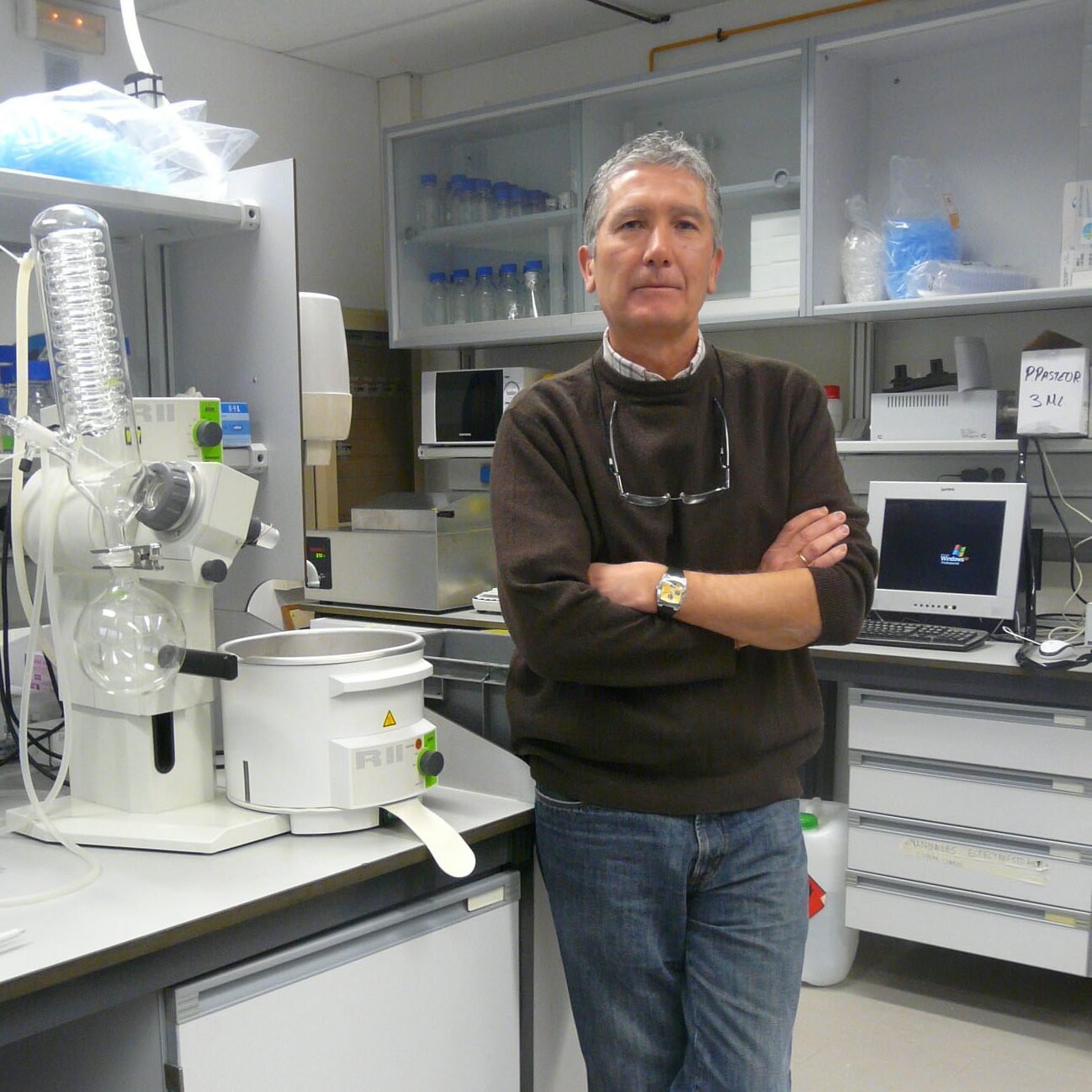
KAT6 Foundation Reaches Milestone as First Funded Research Project is Published
We are proud to report that research led by Dr. José A. Sánchez-Alcázar and his team was published by Genes on November 15, 2022 in an article titled Pantothenate and L-carnitine Supplementation Corrects Pathological Alterations in Cellular Models of KAT6A Syndrome. This is an important milestone for our Foundation as it is the first research project that we directly funded to reach publication, and is an important step forward on the path to finding a treatment for KAT6 individuals. Development of surrogate models simulating KAT6A gene variation is the first step towards understanding the pathophysiological alterations caused by this gene variation. By outlining pathophysiological pathways, treatment model(s) addressing alterations in these pathways can be developed for testing.
Three individuals with KAT6A gene variation participated in the study conducted at Universidad Pablo de Olavide in Spain. An initial series of experiments generated evidence supporting the use of patient-derived fibroblast to study KAT6A gene variation. The team identified four critical pathophysiological processes altered by KAT6A gene variation: 1) Coenzyme A (CoA) metabolism, 2) Iron metabolism, 3) Enzymatic antioxidant system and 4) Mitochondrial function. Two compounds were identified to have a positive impact on the altered physiological pathways. These compounds are: 1) Pantothenate and 2) L-carnitine. Pantothenate is a CoA metabolism activator and L-carnitine is a mitochondrial boosting agent. Supplementation with pantothenate and L-carnitine supported the survival of the KAT6A fibroblast in a stress inducing medium. The concentration of pantothenate and L-carnitine varied in all three KAT6A cell lines suggesting that different type of mutations respond differently to these positive compounds. The KAT6A gene plays a significant role in histone acetylation which is a key process involved in cell progression and differentiation. Supplementation with pantothenate and L-carnitine resulted in significant increase in histone acetylation, recovery of gene expression patterns and expression levels of proteins affected due to the KAT6A gene variation.
We want to extend our sincere thanks to Dr. José A. Sánchez-Alcázar and his entire team for their professionalism and commitment to rare disease research and the KAT6 community. We look forward to building upon this partnership in the future.
Recap of KAT6A & KAT6B Virtual Symposium: GI Health and Beyond
The Gastrointestinal Health and Beyond in Children with Rare Genetic Variations was a 2-hour long, patient-centered, collaborative event organized by the KAT6 Foundation. It was designed to fuel conversation about the gastrointestinal challenges faced by children with KAT6A and KAT6B gene variations and enable open dialogue between families, clinicians, and researchers. The webinar provided a platform for the KAT6 community to expand its network and build connections with new researchers and experts working on tackling GI and GI related issues. More than 90 individuals registered for this event. On the day of the webinar, 20 families and 35 scientists attended the event. With some international representation, the majority of the families and researchers were based in the USA.
Dr. Tanya Tripathi, research coordinator of the KAT6 Foundation moderated three scientific presentations by renowned scientists – Dr. Sarkis Mazmanian, Dr. Gustavo Mostoslavsky and Dr. Richard I Kelley. Please read the summary of the presentations here.

We Urge Doctors to Dig Deeper When Children are Struggling to Gain Weight
The Oxford dictionary defines insidious as: proceeding in a gradual, subtle way, but with harmful effects. Most people associate this term with clever criminals. Today I am writing this to ask you to think about it in another way.
Perhaps the greatest joy a person can experience is welcoming a child into the world. So many dreams and visions for the future. Ideally, those dreams come true. But not always. Sometimes things don’t go as planned. The baby doesn’t learn to walk, to talk, to play with others. These things happen unfortunately, but no one is blamed. In our present day life we have learned how to address these issues – physical therapy, occupational therapy, play therapy, speech therapy are just a few of the remedies that are prescribed, and they usually help to some degree.
But what if the problem is “gradual, subtle, but harmful”? What if the child can’t seem to gain weight, can’t seem to digest food properly? In medical jargon this is called “Failure To Thrive”. But in this case, often, someone is blamed – the parents.
In the last decade genetic testing has revealed dozens of disorders not previously identified. “With a combined prevalence of ~17% among 3- to 17-year-old children in the United States, neurodevelopmental disabilities are the most prevalent chronic medical conditions encountered in primary care” (Savatt, Myers Genetic Testing in Neurodevelopmental Disorders). One of these is a disorder called KAT6A. It is a rare condition that can have devastating effects, including feeding difficulties. As affected infants age, they may experience difficulties feeding because of problems with the movements of the muscles of the face (oromotor dysfunction), swallowing (dysphagia), and there can be a risk of food, liquid or other foreign material accidentally going into the lungs (aspiration). Infants can have additional symptoms involving the gastrointestinal tract including backflow of the contents of the stomach into the esophagus (gastroesophageal reflux), constipation, and abnormally twisting or rotation of the intestines (intestinal malrotation), which can cause pain and bowel obstruction (Esber, KAT6A Syndrome). All of this means the child does not gain weight as expected. But, because this is a rare, newly discovered disorder, the medical community is often unaware that this is a symptom of a syndrome, not a result of parental neglect. Too many parents in these circumstances have been blamed, and even threatened, by professionals who thought they were doing their job. Here are a few of their stories….
We had a failure to thrive diagnosis from the day she was born. She was born hypotonic and with almost no sucking ability (she was also 7 weeks early). Her twin sister developed normally and that should have been a HUGE clue something was wrong with her. We actually did get reported to CPS and had to work six months with a social worker when she was 8 years old to prove it wasn’t what I was doing, but my daughter’s inability to eat and gain weight. We were easily dismissed after six months but the emotional damage done to me was almost irreparable. We did not get our diagnosis till our child was 29 years old. I have played conversations over in my head so many times over the years…
I went through the same thing – my son was dx’d “failure to thrive” at 6 weeks and I was told I wasn’t feeding him enough and the healthiest organic formula I gave him must not be nourishing enough. I researched myself and found he had a TONGUE TIE. I took him to a new pediatrician and she said it was the most severe case she had seen and clipped it right there…
We had a similar issue with our daughter and the dietician accused us of not feeding her enough calories even though we were following the plan she provided for her. She said it wasn’t enough at the following appointment when I read back what we were giving her….which was still the plan she provided…
In October 2020, my son was approximately 1 year and 4 months old. I took my son to get checked out for genetics because he was delayed and showing symptoms of retardation. I explained that we had chosen to make my son’s own food. Specialists came to our house and questioned every step on how we made the foods and sent us to a dietitian once a month. The dietitian did not see anything we did was out of the ordinary. My son continued to not gain weight and I found myself force feeding him to try and put weight on him, as the doctor said she would report us to the Department of Family Services if he did not gain weight and size. An investigator from DFS came to our house. Finally, in February of 2022 genetic testing revealed my son had KAT6A, which explained so much of the issues we were experiencing.Eventually the director of this hospital called to apologize about what had been done to us and let us know that this doctor was no longer working there…
Our family was investigated. However, when our child had to be hospitalized, and the hospital staff fed our daughter, it became clear this was not a problem of neglect…
In our world today with medical discoveries being made every day, it is impossible for anyone to keep up. But, exactly for this reason, it is so important for those that are responsible for the welfare of our children, to not make assumptions that can have devastating effects. The KAT6 Foundation is dedicated to research and raising awareness of KAT6 syndromes and we hope this article will take one step forward in that direction. These links provide more information about KAT6A and KAT6B. Even if your child is thriving, please share this article with your doctors, as it may help avoid the heartache the parents have experienced.
Research Updates
2025 KAT6 Foundation Newly Funded Research Projects
We are pleased to support eight new studies advancing our understanding of KAT6 syndrome.
These projects address disease mechanisms, model development, potential therapies, and biomarkers—laying critical groundwork for clinical trials.
1. Engineering novel genetic tools to unravel the complex KAT6-disease phenotype
Chief Investigator: Effie Apostolou, PhD
Institution: Weill Cornell Medicine, New York City
Dr. Apostolou’s team is working to create a stem cell genetic model which will allow them to control the amount of KAT6A and KAT6B proteins available in a cell. This will allow them to see how different amounts of these proteins affect cell development and highlight future potential therapeutic targets. The group is committed to making their model available to the broader research community. (This study is fully funded by an anonymous donor.)
2. Patient-specific neurodevelopmental models for KAT6B mutations
Principal Investigator: Valerie Arboleda, MD, PhD
Institution: David Geffen School of Medicine, University of California, Los Angeles
This study leverages patient-derived induced pluripotent stem cell (iPSC) lines to investigate how specific KAT6B variants contribute to the phenotypic divergence between Genitopatellar Syndrome (GPS) and Say-Barber-Biesecker-Young-Simpson syndrome (SBBYSS). Brain-like cells grown from patient samples will help researchers understand condition-specific development and open the door to personalized therapies.
3. Neurobehavioral differences in early- and late-truncating KAT6A mouse models
Principal Investigator: Valerie Arboleda, MD, PhD
Institution: David Geffen School of Medicine, University of California, Los Angeles
Dr. Arboleda’s team is creating new, KAT6A variant-specific mouse models to study how different types of KAT6A variants affect brain development and behavior. Based on data from their lab, they will test therapies to see if it can help improve symptoms in mice with severe KAT6A mutations. This study brings us closer to testing treatments that target the specific effects of different mutations in people.
4. Biomarker discovery in KAT6A for translation into clinical trials
Chief Investigator: Sarah Donoghue, MBBS, FRACP
Institution: Murdoch Children’s Research Institute (MCRI), University of Melbourne, Melbourne
This project seeks biomarkers in blood and brain tissues to further understand how cognitive function develops in KAT6A with the hope that we will be able to use this information to measure disease progression and treatment success. This work is building on multi-Omic work that we are doing in the lab to characterize KAT6A models of mice and KAT6A human cortical neuron experiments. We are hoping to understand the impact of KAT6A on brain function in mice and whether carnitine treatment improves this, paving the way for future human trials. Together, these studies will help get us closer to starting clinical trials in people with KAT6A syndrome.
5. A multidisciplinary clinical program and identification of a metabolomic profile in KAT6A/KAT6B conditions to inform clinical trial readiness
Co-Investigators: Olaf Bodamer, MD, PhD andWilliam Brucker, MD, PhD
Institution: Boston Children’s Hospital & Harvard Medical School, Boston
Dr. Bodamer is launching a new clinical program for patients with KAT6A and KAT6B syndromes at Boston Children’s Hospital. The team will collect detailed health data and samples from patients to better understand the natural course of these conditions. They’ll also search for unique biomarkers that could help doctors know when a treatment is working. This project combines high-quality patient care with research aimed at preparing for future clinical trials.
6. Epigenetic landscapes and gene regulation in KAT6 disorders
Co-Investigators: Maria A. Serrano, PhD and Gustavo Mostoslavsky, MD, PhD
Institution: Center for Regenerative Medicine & Boston University Chobanian & Avedisian School of Medicine, Boston
This research examines how KAT6 mutations affect gene regulation in brain, gut, and blood cells. The team will use an advanced method to see how these cells’ “epigenetic landscapes” (chemical markers that control gene activity) are different from healthy cells. It may also identify blood-based biomarkers for easier monitoring of disease progression and treatment.
7. CA3 neuronal development in KAT6A and KAT6B patient-derived iPSCs
Principal Investigators: Thomas Durcan, PhD, Faïza Benaliouad, PhD and Gilles Maussion, PhD
Institution: Neuro: Montreal Neurological Institute-Hospital & McGill University, Montreal
Focusing on the CA3 hippocampal region linked to memory, this study uses patient-derived stem cells to uncover how brain cell development is altered in KAT6 syndromes. The goal is to find points for therapeutic intervention.
8. When Proteins Go Wrong: Unravelling the Impact of KAT6 Variants on Protein Structure and Function
Principal Investigator: Shabih Shakeel, PhD
Institution: Walter and Eliza Hall Institute of Medical Research
This project is focused on characterizing the effects of different KAT6A and KAT6B mutations on protein structure and important protein functions such as binding with protein partners and acetylation. They will do this first characterization by isolating the proteins and studying them in test tubes. Dr. Shakeel’s team will then see how these changes in function lead to downstream changes to actual cells. (This study is fully funded by an anonymous donor.)
MCRI is Seeking Participants for New KAT6A Research Study
Biomarker discovery in KAT6A for translation into clinical trials
For KAT6A syndrome and other neurodevelopmental disorders, researchers are starting to understand the dysregulated cellular processes affecting neurons and their supporting cells. The Chromatin Disorders Research Team at Murdoch Children’s Research Institute is currently using a mouse model, alongside human cortical neurons to study gene expression and metabolomics KAT6A syndrome, in collaboration with Professor Anne Voss at the Walter and Eliza Hall Institute of Medical Research. This work is being led by PhD student Dr Sarah Donoghue and supervised by Professor David Amor and Professor Paul Lockhart. The goal of this project is to understand the differences in brain development that occur in KAT6A syndrome, and to identify biomarkers that may show response to treatment in clinical trials.
The team is looking to extend their work on blood biomarkers in KAT6A mice to children and adults with KAT6A syndrome. In this project, they will measure a range of molecular compounds in blood samples from human participants with KAT6A syndrome, using untargeted metabolomic and proteomic analyses. They will compare the plasma profile of 50 KAT6A syndrome participants to the plasma samples of 20 participants without KAT6A syndrome. The aim is to identify biomarkers that are detectable in the plasma of participants with KAT6A syndrome, with the hope that these can be translated for use in clinical trials, as an objective measure of treatment efficacy as the community proceeds to clinical trials.
For more information about this research, please contact Sarah Donoghue at sarah.donoghue@mcri.edu.au.

Attention Researchers
ATTENTION RESEARCHERS:
The KAT6 Foundation is addressing a critical research priority raised by families—gastrointestinal challenges faced by children with KAT6A and KAT6B. This population experiences a concerning increase in mortality due to poor GI motility and perforation. Tragically, we recently lost another child to GI perforation, which has heightened anxiety and urgency within the community.
We are keen to better understand the factors that contribute to susceptibility to poor motility, bowel obstruction, and the risk of perforation in children with KAT6A and KAT6B. Equally important is identifying effective treatment strategies to address these serious issues.If you are interested in collaborating on this important challenge, please email the KAT6 Foundation at support@kat6a.org.
Learn more about Bowel Obstructions in the KAT6 Population.
KAT6 Foundation Reaches Milestone as First Funded Research Project is Published
We are proud to report that research led by Dr. José A. Sánchez-Alcázar and his team was published by Genes on November 15, 2022 in an article titled Pantothenate and L-carnitine Supplementation Corrects Pathological Alterations in Cellular Models of KAT6A Syndrome. This is an important milestone for our Foundation as it is the first research project that we directly funded to reach publication, and is an important step forward on the path to finding a treatment for KAT6 individuals. Development of surrogate models simulating KAT6A gene variation is the first step towards understanding the pathophysiological alterations caused by this gene variation. By outlining pathophysiological pathways, treatment model(s) addressing alterations in these pathways can be developed for testing.
Three individuals with KAT6A gene variation participated in the study conducted at Universidad Pablo de Olavide in Spain. An initial series of experiments generated evidence supporting the use of patient-derived fibroblast to study KAT6A gene variation. The team identified four critical pathophysiological processes altered by KAT6A gene variation: 1) Coenzyme A (CoA) metabolism, 2) Iron metabolism, 3) Enzymatic antioxidant system and 4) Mitochondrial function. Two compounds were identified to have a positive impact on the altered physiological pathways. These compounds are: 1) Pantothenate and 2) L-carnitine. Pantothenate is a CoA metabolism activator and L-carnitine is a mitochondrial boosting agent. Supplementation with pantothenate and L-carnitine supported the survival of the KAT6A fibroblast in a stress inducing medium. The concentration of pantothenate and L-carnitine varied in all three KAT6A cell lines suggesting that different type of mutations respond differently to these positive compounds. The KAT6A gene plays a significant role in histone acetylation which is a key process involved in cell progression and differentiation. Supplementation with pantothenate and L-carnitine resulted in significant increase in histone acetylation, recovery of gene expression patterns and expression levels of proteins affected due to the KAT6A gene variation.
We want to extend our sincere thanks to Dr. José A. Sánchez-Alcázar and his entire team for their professionalism and commitment to rare disease research and the KAT6 community. We look forward to building upon this partnership in the future.
Recap of KAT6A & KAT6B Virtual Symposium: GI Health and Beyond
The Gastrointestinal Health and Beyond in Children with Rare Genetic Variations was a 2-hour long, patient-centered, collaborative event organized by the KAT6 Foundation. It was designed to fuel conversation about the gastrointestinal challenges faced by children with KAT6A and KAT6B gene variations and enable open dialogue between families, clinicians, and researchers. The webinar provided a platform for the KAT6 community to expand its network and build connections with new researchers and experts working on tackling GI and GI related issues. More than 90 individuals registered for this event. On the day of the webinar, 20 families and 35 scientists attended the event. With some international representation, the majority of the families and researchers were based in the USA.
Dr. Tanya Tripathi, research coordinator of the KAT6 Foundation moderated three scientific presentations by renowned scientists – Dr. Sarkis Mazmanian, Dr. Gustavo Mostoslavsky and Dr. Richard I Kelley. Please read the summary of the presentations here.
Recap of KAT6A & KAT6B Virtual Symposium: Speech & Language
On March 24, 2022, The KAT6A Foundation hosted the second KAT6A and KAT6B Virtual Symposium. The event was designed to solidify the KAT6A and KAT6B research network of clinicians and researchers through identification of research gaps, opportunities and collaborations. The symposium series aims to drive patient- centered and collaborative research to improve outcomes for individuals with KAT6A and KAT6B syndromes. The symposium series also aims to spark new collaborations among the KAT6A and KAT6B research groups and healthcare communities.The first KAT6A and KAT6B symposium, conducted in 2021, discussed a range of neurodevelopmental challenges faced by children with KAT6A and KAT6B gene variations. The second symposium expanded on the stakeholder representation to include parents of children with KAT6A and KAT6B gene variations along with health care professionals, clinicians, and researchers. This symposium focused on understanding the impact of KAT6A and KAT6B gene variations on speech and language development, a domain that is most commonly affected in this population of children.10 speakers and nearly 60 members of the KAT6 community attended the the symposium. The symposium ran for three hours and was organized in two sessions: the first session provided an overview of the KAT6A Foundation’s goal to empower patient-centered research and initiatives led by the Foundation to support research. The second session focused on understanding the pathophysiology of KAT6A and KAT6B related speech and language disorders.
Please read the symposium recap pdf for a complete summary of each presentation. The next virtual symposium is tentatively scheduled in September 2022. This symposium will focus on unraveling the range of gastrointestinal difficulties faced by individuals diagnosed with KAT6A and KAT6B syndromes.